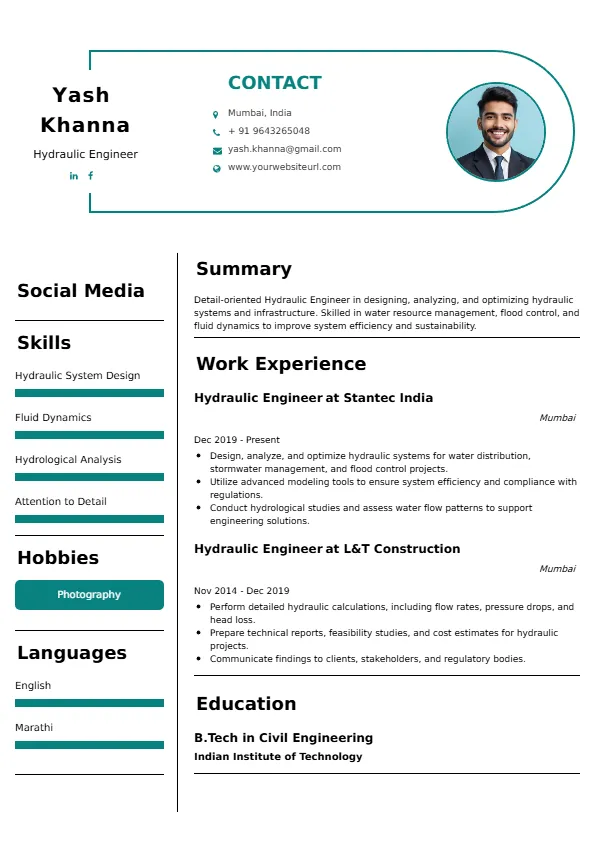
Hydraulic Engineer
Welcome to our Hydraulic Engineer resume sample page! This expertly crafted resume template is designed to showcase your expertise in designing, analyzing, and optimizing systems that utilize fluid power (e.g., industrial machinery, construction equipment, water resources). Whether you're an entry-level candidate or a seasoned professional, this sample highlights key skills like Fluid Mechanics, Hydraulic Circuit Design, CAD/Simulation Software (e.g., AutoCAD, MATLAB), component selection (pumps, valves), and performance testing tailored to meet top manufacturing, aerospace, and civil engineering demands. Use this guide to create a compelling resume that stands out and secures your next career opportunity.
Superbresume.com empowers Hydraulic Engineers to craft resumes that highlight their fluid power system design and simulation expertise. Our platform offers customizable templates tailored for specialized engineering roles, emphasizing skills like electro-hydraulic controls, pressure/flow analysis, FMEA (Failure Mode and Effects Analysis), and integration with mechanical/electrical systems. With ATS-optimized formats, expert-written content suggestions, and real-time resume analysis, we ensure your resume aligns with job descriptions. Showcase your experience in designing systems that reduced energy consumption, optimizing component size for cost savings, or successfully troubleshooting complex system failures with confidence. Superbresume.com helps you create a polished, results-driven resume that grabs hiring managers’ attention and lands interviews.
How to Write a Resume for a Hydraulic Engineer
Craft a Targeted Summary: Write a 2-3 sentence summary highlighting your expertise in designing and analyzing hydraulic/fluid power systems, proficiency in simulation software and industry standards, and success in optimizing system efficiency and reliability.
Use Reverse-Chronological Format: List recent hydraulic, mechanical, or fluid power engineering roles first, focusing on measurable design, analysis, and optimization achievements.
Highlight Certifications/Training: Include credentials like Professional Engineer (PE) license, specialized training in Fluid Power (e.g., NFPA), advanced simulation software certification, or relevant Master’s Degree to boost credibility.
Quantify Achievements: Use metrics, e.g., “Designed a high-pressure hydraulic circuit that increased machine actuation speed by 15% while reducing energy consumption by 10%,” or “Conducted FMEA on a core fluid power system, mitigating 5 critical failure modes and saving $100K in warranty costs,” to show impact.
Incorporate Keywords: Use terms like “Hydraulic Circuit Design,” “Fluid Mechanics,” “Component Sizing (Pumps/Valves),” “Pressure/Flow Analysis,” “Simulation Software (MATLAB/Simulink),” “Electro-Hydraulic Controls,” “System Optimization,” or “Failure Mode and Effects Analysis (FMEA)” from job descriptions for ATS.
Detail Technical Skills: List proficiency with specific CAD software (AutoCAD, SolidWorks), simulation tools (SimHydraulics, AMESim), control programming (PLC/C++), testing equipment (flow meters, pressure transducers), and industry standards in a comprehensive skills section.
Showcase Design Projects: Highlight 3-4 key hydraulic systems or components designed, detailing the application (e.g., construction equipment, aerospace actuator), the design challenge, the methodology, and the quantified performance/cost outcome.
Emphasize Soft Skills: Include analytical rigor, systematic problem-solving (for leaks/failures), attention to safety/detail, and cross-functional collaboration (with mechanical/electrical teams).
Keep It Concise: Limit your resume to 1-2 pages, focusing on relevant hydraulic design, analysis, and system optimization experience.
Proofread Thoroughly: Eliminate typos or jargon for a professional document.
Electro-Hydraulic Control and Digitalization: Focus on expertise designing complex systems that integrate digital electronics, sensors, and microcontrollers for precise, efficient control of hydraulic actuators and valves.
Energy Efficiency and Power Density: Highlight designing systems that minimize energy loss through optimized component selection, variable speed drives, and load-sensing pumps to meet sustainability goals.
Simulation and Digital Twin: Showcase proficiency utilizing advanced simulation software (e.g., Simscape, AMESim) to model, test, and validate hydraulic system performance digitally before physical prototyping.
Condition Monitoring and Predictive Maintenance (PdM): Detail experience integrating sensors (pressure, temperature, particle count) and data analytics to predict component wear, reduce downtime, and optimize fluid change intervals.
Additive Manufacturing for Components: Include awareness or experience designing hydraulic manifolds or components optimized for production via 3D printing for weight or size reduction.
Metrics-Driven Achievements: Use results like “Reduced the physical size of a hydraulic manifold block by 25% through optimized CAD routing” or “Improved system reliability (MTBF) by 15% via a new filtration and monitoring strategy.”
Integration with Mechanical/Software: Emphasize the ability to design interfaces and controls that seamlessly integrate the hydraulic system with the larger mechanical structure and control software.
Safety and Contamination Control: Highlight deep knowledge of fluid contamination control standards (ISO codes) and designing systems for easy, safe maintenance access.
Choose Superbresume.com to craft a Hydraulic Engineer resume that stands out in the competitive fluid power sector. Our platform offers tailored templates optimized for ATS, ensuring your skills in circuit design, fluid mechanics, and simulation software shine. With expert guidance, pre-written content, and real-time feedback, we help you highlight achievements like reducing energy consumption or optimizing component performance. Whether you design for mobile equipment or industrial presses, our tools make it easy to create a polished, results-driven resume. Trust Superbresume.com to showcase your expertise in engineering efficient, reliable, and powerful hydraulic systems. Start building your career today!
20 Key Skills for a Hydraulic Engineer Resume
| Hydraulic Circuit Design (CAD) | Fluid Mechanics & Thermodynamics |
| Electro-Hydraulic Control Systems | Simulation Software (MATLAB/Simulink, AMESim) |
| Component Selection & Sizing (Pumps, Valves, Actuators) | Pressure/Flow Analysis & Optimization |
| FMEA (Failure Mode and Effects Analysis) | Contamination Control (ISO Codes) |
| System Testing & Validation | Advanced CAD Software (AutoCAD/SolidWorks) |
| PLC Programming (Basic Control Logic) | Root Cause Analysis (RCFA) |
| System Integration (Mechanical/Electrical) | Predictive Maintenance (PdM) Strategy |
| High-Pressure/High-Flow Applications | Safety Standards Adherence |
| Analytical Rigor | Troubleshooting (System Failure) |
10 Do’s for a Hydraulic Engineer Resume
Tailor Your Resume: Customize for the specific industry (e.g., emphasize aerospace standards, emphasize mobile equipment design).
Highlight Certifications/Training: List PE license, NFPA Fluid Power certification, or advanced simulation training prominently.
Quantify Achievements: Include metrics on efficiency gains (power/flow), size/pressure of systems designed, cost reduction from optimization, or complexity of failures mitigated.
Use Action Verbs: Start bullet points with verbs like “designed,” “analyzed,” “optimized,” “simulated,” or “integrated.”
Showcase Design Projects: Detail the methodology and the strategic, quantified performance/cost outcome of 3-4 key hydraulic design or analysis projects.
Include Soft Skills: Highlight analytical rigor, systematic problem-solving, attention to safety/detail, and cross-functional collaboration.
Optimize for ATS: Use standard engineering section titles and incorporate key fluid power, simulation, and regulatory terms.
Keep It Professional: Use a clean, consistent font and engineering layout.
Emphasize Modeling and Simulation: Clearly articulate experience using software to predict and validate system performance.
Proofread Thoroughly: Ensure no typos or errors in technical terms, software names, or metrics.
10 Don’ts for a Hydraulic Engineer Resume
Don’t Overload with Jargon: Avoid confusing, internal company acronyms; use standardized fluid power and engineering terminology.
Don’t Exceed Two Pages: Keep your resume concise, focusing on high-impact hydraulic design, analysis, and optimization achievements.
Don’t Omit Dates: Include employment dates for career context.
Don’t Use Generic Templates: Tailor your resume specifically to the specialized fluid dynamics and control duties of a Hydraulic Engineer.
Don’t List Irrelevant Skills: Focus on fluid mechanics, circuit design, component selection, simulation, and controls.
Don’t Skip Metrics: Quantify results wherever possible; all achievements must link back to system efficiency, performance, or cost reduction.
Don’t Use Complex Formats: Avoid highly stylized elements or confusing graphics.
Don’t Ignore Controls: Include explicit experience integrating hydraulic systems with electrical or software controls (PLC, microcontrollers).
Don’t Include Outdated Experience: Omit non-engineering or irrelevant jobs over 15 years old.
Don’t Forget to Update: Refresh for new PE license achievement, successful design projects, or advanced simulation tool mastery.
5 FAQs for a Hydraulic Engineer Resume
Prioritize hydraulic circuit design (CAD), fluid mechanics, component selection/sizing, electro-hydraulic controls, and simulation software proficiency.
Use standard engineering section titles, avoid graphics, and include keywords like “FMEA,” “Electro-Hydraulic,” and “Simulink.”
Yes, if obtained or if progress is underway, it should be listed prominently.
Detail a design change (e.g., pump choice, circuit routing) and the resulting quantified reduction in energy consumption or heat generation in the system.
Use a reverse-chronological format to emphasize your most recent, high-impact design and optimization achievements.
Get 5x more interviews with our crafted Resumes. We make resumes that land jobs.

Get a Free Customized Cover Letter with Resume Expert Advice
with every resume order placed, you will get a free Customized Cover letter.