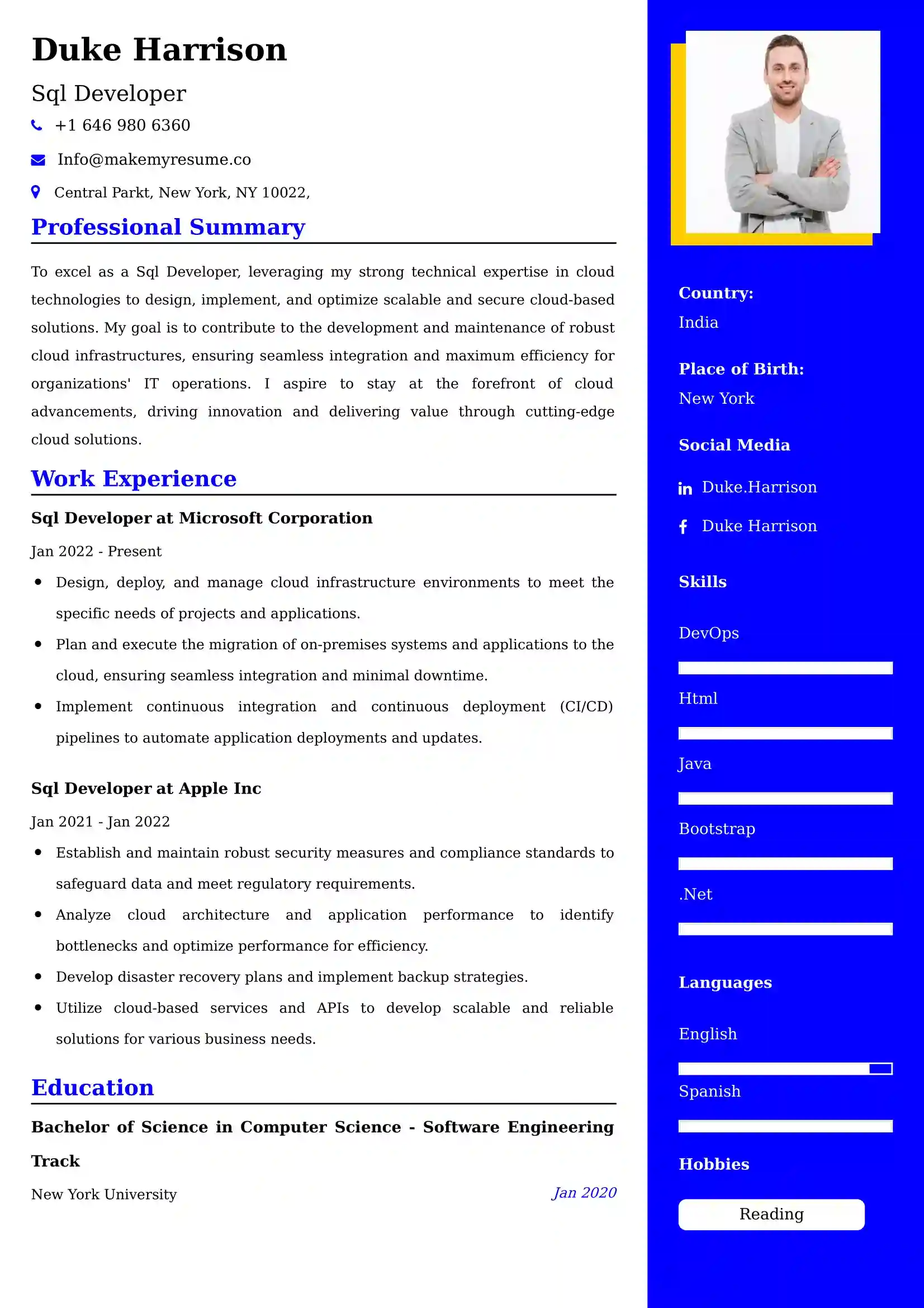
SQL Developer
Welcome to our SQL Developer resume sample page! This expertly crafted resume template is designed to showcase your expertise in designing, developing, and optimizing relational database schemas, writing complex SQL queries, building stored procedures/functions, and ensuring data integrity and performance. Whether you focus on application backends, data warehousing, or reporting, this sample highlights key skills like Advanced SQL, Database Design (Normalization), Performance Tuning (Indexing/Query Plans), Stored Procedures/Functions, and ETL/ELT Pipeline Development tailored to meet top tech and data demands. Use this guide to create a polished, results-driven resume that stands out and secures your next career opportunity.
How to Write a Resume for a SQL Developer
Craft a Targeted Summary: Write a 2-3 sentence summary highlighting your expertise in full-cycle SQL database development, proficiency in advanced SQL and performance tuning, and success in designing scalable, reliable schemas for high-performance applications and reporting.
Use Reverse-Chronological Format: List recent SQL developer, database engineering, or back-end development roles first, focusing on measurable scalability and performance achievements.
Highlight Certifications/Training: Include credentials like Microsoft Certified: Azure Data Engineer Associate, Oracle Certified Professional (OCP), specialized SQL optimization training, or relevant database/CS degrees to boost credibility.
Quantify Achievements: Use metrics, e.g., “Optimized a core dashboard reporting query using indexing and stored procedure refactoring, reducing execution time from 90 seconds to 5 seconds,” or “Designed and implemented the schema for a new data warehouse, handling 10TB of data and supporting 100+ concurrent analytical queries,” to show impact.
Incorporate Keywords: Use terms like “Advanced SQL (T-SQL/PL-SQL),” “Database Design & Normalization (3NF),” “Query Optimization & Performance Tuning,” “Stored Procedures/Functions,” “ETL/ELT Pipeline Development,” “Indexing Strategy,” or “Data Warehousing” from job descriptions for ATS.
Detail Technical Skills: List proficiency with specific database systems (SQL Server, PostgreSQL, MySQL), tools (SSMS, Azure Data Studio, pgAdmin), ETL tools (SSIS, Informatica), scripting (Python), and database version control (Flyway/Liquibase) in a comprehensive skills section.
Showcase Database Projects: Highlight 3-4 key schema designs, stored procedures, or optimization projects, detailing the database system used, the complexity solved, and the measurable application/user outcome.
Emphasize Soft Skills: Include analytical rigor, systematic problem-solving (slow queries, deadlocks), attention to detail (data integrity), and collaboration (application developers, data analysts).
Keep It Concise: Limit your resume to 1-2 pages, focusing on relevant SQL development, scaling, and optimization experience.
Proofread Thoroughly: Eliminate typos or jargon for a professional document.
Cloud Database Services and Performance: Focus on expertise deploying, managing, and optimizing SQL databases within cloud environments (AWS RDS/Aurora, Azure SQL DB), utilizing cloud-native performance features.
Advanced Query Optimization and Indexing: Highlight deep expertise utilizing query execution plans, trace tools, and advanced indexing strategies (e.g., clustered, non-clustered, columnstore) to minimize I/O and latency for critical transactions/reports.
ETL/ELT Pipeline Development (Modern Stack): Showcase proficiency utilizing modern ETL/ELT tools (dbt, Fivetran, Python scripts) to design and manage robust data pipelines that feed data warehouses (Snowflake, BigQuery).
Database DevOps (DbOps) and Version Control: Detail experience integrating database schema and code changes (Stored Procedures, Functions) into the CI/CD pipeline using tools like Flyway or Liquibase for safe, automated deployment.
Performance Monitoring and Tuning: Emphasize using specialized monitoring tools (SQL Server Profiler, pg_stat_statements) to proactively identify slow queries, deadlocks, and resource bottlenecks for performance tuning.
Metrics-Driven Achievements: Use results like “Successfully optimized 10+ high-volume stored procedures, reducing the associated application timeout errors by 90%” or “Implemented a data partitioning strategy that reduced data warehouse load time by 40%.”
Polyglot Persistence and Integration: Include experience integrating SQL databases seamlessly with NoSQL stores (e.g., MongoDB, Redis) or data lakes using change data capture (CDC) or messaging queues (Kafka).
Security and Compliance: Highlight experience implementing robust database security (encryption, access controls, auditing) and ensuring compliance with data privacy regulations.
Choose Superbresume.com to craft a SQL Developer resume that stands out in the competitive relational database sector. Our platform offers tailored templates optimized for ATS, ensuring your skills in Advanced SQL, query optimization, and database design shine. With expert guidance, pre-written content, and real-time feedback, we help you highlight achievements like boosting query speed or designing resilient data architectures. Whether you focus on application backends or enterprise reporting, our tools make it easy to create a polished, results-driven resume. Trust Superbresume.com to showcase your expertise in engineering robust, high-performance SQL solutions. Start building your career today!
20 Key Skills for a SQL Developer Resume
| Advanced SQL (T-SQL/PL-SQL, Window Functions) | Query Optimization & Performance Tuning (Indexing) |
| Database Design & Normalization (3NF/BCNF) | Stored Procedures, Functions, & Triggers |
| ETL/ELT Pipeline Development (SSIS/Python) | Database Administration (DBA) Fundamentals |
| Data Warehousing & Dimensional Modeling | Cloud Database Management (AWS RDS/Azure SQL) |
10 Do’s for a SQL Developer Resume
Tailor Your Resume: Customize for the specific database system (e.g., emphasize T-SQL/SSIS for SQL Server, emphasize PL/pgSQL for PostgreSQL).
Highlight Certifications/Training: List OCP, Microsoft Azure/SQL certifications, and advanced SQL/data training prominently.
Quantify Achievements: Include metrics on query latency reduction, throughput (transactions/sec), data volume managed (TB), or efficiency gains from ETL/Stored Procedures.
Use Action Verbs: Start bullet points with verbs like “designed,” “optimized,” “developed,” “scaled,” or “automated.”
Showcase Performance Projects: Detail the methodology and the strategic, quantified performance/scalability outcome of 3-4 key SQL or database projects.
Include Soft Skills: Highlight analytical rigor, systematic problem-solving (query tuning), attention to detail (data integrity), and collaboration.
Optimize for ATS: Use standard engineering/data section titles and incorporate key SQL, database, and system terms.
Keep It Professional: Use a clean, consistent font and engineering layout.
Emphasize Optimization and Schema Design: Clearly articulate expertise in writing complex, efficient SQL and architecting robust schemas.
Proofread Thoroughly: Eliminate typos or jargon for a professional document.
10 Don’ts for a SQL Developer Resume
Don’t Overload with Jargon: Avoid confusing, internal company acronyms; use standardized SQL and database terminology.
Don’t Exceed Two Pages: Keep your resume concise, focusing on high-impact SQL development, scaling, and optimization achievements.
Don’t Omit Dates: Include employment dates for career context.
Don’t Use Generic Templates: Tailor your resume specifically to the robust, relational duties of a SQL Developer.
Don’t List Irrelevant Skills: Focus on SQL, database design, performance tuning, stored procedures, and ETL.
Don’t Skip Metrics: Quantify results wherever possible; latency, throughput, and data volume are critical metrics.
Don’t Use Complex Formats: Avoid highly stylized elements or confusing graphics.
Don’t Ignore ETL/Data Warehousing: Include explicit experience building data pipelines and dimensional models if applicable.
Don’t Include Outdated Experience: Omit non-SQL or irrelevant jobs over 15 years old.
Don’t Forget to Update: Refresh for new certification mastery, successful performance optimization projects, or advanced cloud database skills.
5 FAQ's for a SQL Developer Resume
Clearly state if you are an expert in SQL Server, PostgreSQL, MySQL, or Oracle.
"Optimized slow-running queries, reducing report generation time by 70% and minimizing server load."
Yes. Mention using SSIS, Informatica, or Python to move and transform data between systems.
"Designed and implemented normalized relational schemas and star schemas for high-performance data warehousing."
Yes. Mention maintaining comprehensive data dictionaries and technical documentation for all database objects.
Get 5x more interviews with our crafted Resumes. We make resumes that land jobs.

Get a Free Customized Cover Letter with Resume Expert Advice
with every resume order placed, you will get a free Customized Cover letter.