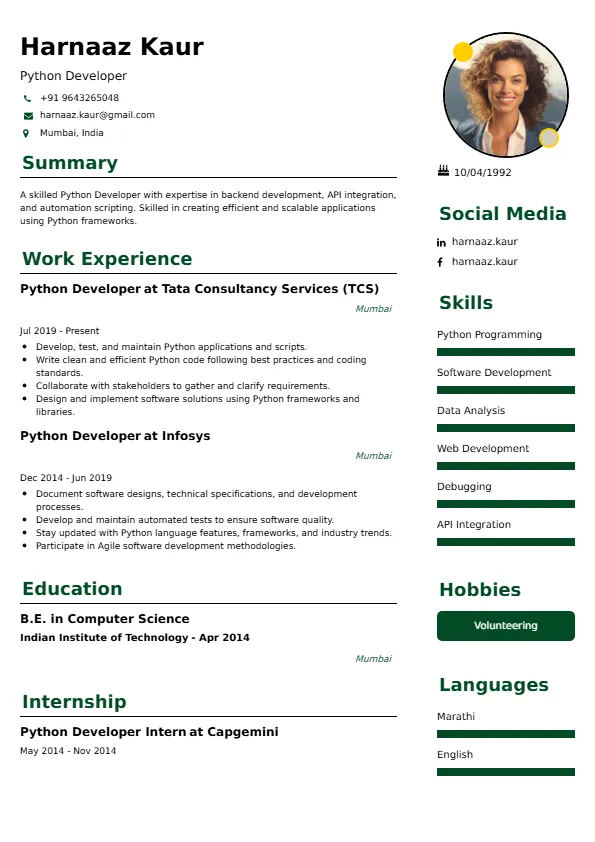
Python Developer
Welcome to our Python Developer resume sample page! This expertly crafted resume template is designed to showcase your expertise in designing, developing, and deploying robust applications, APIs, and data pipelines using the Python language and its rich ecosystem (e.g., Django, Flask, Pandas, NumPy). Whether you focus on back-end web development, data science, or automation, this sample highlights key skills like Python 3, Framework Mastery (Django/Flask), REST API Development, Database/ORM, and Cloud/DevOps Practices tailored to meet top tech and data demands. Use this guide to create a polished, results-driven resume that stands out and secures your next career opportunity.
Superbresume.com empowers Python Developers to craft resumes that highlight their application versatility and system scalability expertise. Our platform offers customizable templates tailored for software roles, emphasizing skills like advanced data manipulation (Pandas/NumPy), microservices integration, performance optimization, and robust CI/CD pipeline development. With ATS-optimized formats, expert-written content suggestions, and real-time resume analysis, we ensure your resume aligns with job descriptions. Showcase your experience in building high-throughput APIs, optimizing data processing speed, or successfully leading the automation of critical business workflows with confidence. Superbresume.com helps you create a polished, results-driven resume that grabs hiring managers’ attention and lands interviews.
How to Write a Resume for a Python Developer
Craft a Targeted Summary: Write a 2-3 sentence summary highlighting your expertise in Python application development (specify focus: Web/Data/ML), proficiency in core frameworks and databases, and success in designing and deploying scalable, high-performance software solutions.
Use Reverse-Chronological Format: List recent Python development, software engineering, or data science roles first, focusing on measurable performance and system design achievements.
Highlight Certifications/Portfolio: Include credentials like Python Institute Certified (PCEP/PCDP), relevant cloud certifications (AWS/Azure), or feature a GitHub/Portfolio link showcasing code/live APIs/data pipelines to boost credibility.
Quantify Achievements: Use metrics, e.g., “Developed a core REST API using Django that scaled to support 100K daily users with sub-100ms latency,” or “Automated a data ingestion workflow using Pandas/SQL, reducing processing time from 4 hours to 30 minutes,” to show impact.
Incorporate Keywords: Use terms like “Python 3 (OOP),” “Django/Flask/FastAPI,” “REST API Development,” “Data Analysis (Pandas/NumPy),” “Database/ORM (SQLAlchemy/Django ORM),” “Microservices Architecture,” or “CI/CD & DevOps” from job roles for ATS.
Detail Technical Skills: List proficiency with specific frameworks, libraries (requests, asyncio), databases (PostgreSQL, MongoDB), cloud services, testing tools (Pytest), and version control (Git) in a comprehensive skills section.
Showcase Development Projects: Highlight 3-4 key APIs, data pipelines, or system features built, detailing the technology stack used, the architectural challenge solved (e.g., scaling, async processing), and the measurable performance/business outcome.
Emphasize Soft Skills: Include systematic problem-solving, attention to detail (code quality), performance consciousness, and collaboration (with data scientists/front-end teams).
Keep It Concise: Limit your resume to 1-2 pages, focusing on relevant Python development, system architecture, and optimization experience.
Proofread Thoroughly: Eliminate typos or jargon for a professional document.
API Development for Microservices: Focus on expertise designing and deploying high-performance, asynchronous APIs (e.g., using FastAPI, Django Rest Framework) to support modern microservices architecture and cloud-native applications.
Data Engineering and ETL/ELT: Highlight deep proficiency using libraries like Pandas, NumPy, and Spark (PySpark) to build robust, scalable data ingestion, transformation, and processing pipelines (ETL/ELT).
Cloud and Container Deployment: Showcase experience deploying Python applications as containerized services (Docker/Kubernetes) and managing them in public cloud environments (AWS Lambda, Google Cloud Run).
Asynchronous Programming (Asyncio/Aiohttp): Detail expertise utilizing Python's asyncio for high-concurrency operations (e.g., web scraping, fast API I/O), achieving better performance than traditional multi-threading.
MLOps and AI Integration: If applicable, include experience packaging, deploying, and monitoring machine learning models built in Python (TensorFlow/PyTorch) using tools like MLflow or SageMaker.
Metrics-Driven Achievements: Use results like “Optimized a core API service to handle 2x the traffic load without additional infrastructure scaling” or “Automated a data cleaning process that reduced reporting errors by 15%.”
Code Quality and Testing Rigor: Emphasize commitment to TDD (Test-Driven Development), writing comprehensive unit and integration tests (Pytest/Unittest), and adhering to PEP 8 standards.
NoSQL Database Integration: Highlight experience working with flexible document/NoSQL databases (e.g., MongoDB, Cassandra) for specific application data needs, alongside traditional SQL databases.
Choose Superbresume.com to craft a Python Developer resume that stands out in the competitive software and data engineering sector. Our platform offers tailored templates optimized for ATS, ensuring your skills in Django/Flask, data analysis (Pandas), and system scalability shine. With expert guidance, pre-written content, and real-time feedback, we help you highlight achievements like boosting API throughput or automating complex data workflows. Whether you build back-end services or ML pipelines, our tools make it easy to create a polished, results-driven resume. Trust Superbresume.com to showcase your expertise in engineering versatile, high-performance Python solutions. Start building your career today!
20 Key Skills for a Python Developer Resume
| Python 3 (OOP, Performance) | Web Frameworks (Django, Flask, FastAPI) |
| REST API Development & Microservices | Data Analysis & Manipulation (Pandas, NumPy) |
| Database/ORM (PostgreSQL, SQLAlchemy, Django ORM) | Cloud Deployment (AWS/Azure/GCP, Serverless) |
| CI/CD & DevOps Practices | Testing (Pytest, Unittest, TDD) |
| Asynchronous Programming (Asyncio) | Containerization (Docker/Kubernetes) |
| ML Frameworks (TensorFlow/Scikit-learn, if applicable) | Advanced SQL & Database Querying |
10 Do’s for a Python Developer Resume
Tailor Your Resume: Customize for the specific focus (e.g., emphasize data/Pandas for a data role, emphasize Django/API for a web role).
Highlight Certifications/Training: List Python Institute/OCP, relevant cloud certifications, and feature a GitHub link prominently.
Quantify Achievements: Include metrics on latency reduction, data processing time reduction, throughput (requests/sec), or efficiency gains from automation.
Use Action Verbs: Start bullet points with verbs like “developed,” “optimized,” “architected,” “automated,” or “integrated.”
Showcase Development Projects: Detail the framework used, the architectural challenge solved (e.g., concurrency, data volume), and the measurable performance/business outcome.
Include Soft Skills: Highlight systematic problem-solving, attention to detail (code quality), performance consciousness, and collaboration.
Optimize for ATS: Use standard engineering/data section titles and incorporate key frameworks, tools, and technical terms.
Keep It Professional: Use a clean, consistent font and engineering layout.
Emphasize Libraries and Frameworks: Clearly state proficiency in core libraries (Pandas, NumPy) and web frameworks.
Proofread Thoroughly: Eliminate typos or jargon for a professional document.
10 Don’ts for a Python Developer Resume
Don’t Overload with Jargon: Avoid confusing, internal company acronyms; use standardized Python and architecture terminology.
Don’t Exceed Two Pages: Keep your resume concise, focusing on high-impact Python development and system architecture achievements.
Don’t Omit Dates: Include employment dates for career context.
Don’t Use Generic Templates: Tailor your resume specifically to the versatile, scalable duties of a Python Developer.
Don’t List Irrelevant Skills: Focus on Python, frameworks, data libraries, APIs, databases, and cloud/DevOps.
Don’t Skip Metrics: Quantify results wherever possible; speed, throughput, and efficiency are critical metrics.
Don’t Use Complex Formats: Avoid highly stylized elements or confusing graphics.
Don’t Ignore Testing/DevOps: Include explicit experience with automated testing and CI/CD integration.
Don’t Include Outdated Experience: Omit low-level, non-programming, or irrelevant IT jobs over 15 years old.
Don’t Forget to Update: Refresh for new framework versions, successful microservices deployments, or advanced data science library mastery.
5 FAQ's for a Python Developer Resume
Prioritize Django, Flask, or FastAPI for web development, or Pandas, NumPy, and Scikit-learn for data-focused roles.
Mention specific results: "Refactored a data processing script, reducing execution time by 60% and CPU usage by 30% through multiprocessing."
Yes. Mention deploying Python applications using Docker, Kubernetes, and AWS (Lambda/EC2).
Focus on impact: "Developed a Python-based automation suite that eliminated 15 hours of manual data entry weekly."
Absolutely. Mention your adherence to PEP 8 standards, use of PyTest/Unittest, and experience with CI/CD pipelines.
Get 5x more interviews with our crafted Resumes. We make resumes that land jobs.

Get a Free Customized Cover Letter with Resume Expert Advice
with every resume order placed, you will get a free Customized Cover letter.