Product Designer
Welcome to our Product Designer resume sample page! This expertly crafted resume template is designed to showcase your expertise in leading the design of digital products (UX/UI), conducting user research, prototyping, and collaborating closely with product managers and engineers to ship user-centered solutions. Whether you focus on mobile, web, or enterprise software, this sample highlights key skills like Figma/Sketch/Adobe XD, User Research (Qualitative/Quantitative), Design Systems, Prototyping, and End-to-End UX/UI Design tailored to meet top tech and design demands. Use this guide to create a polished, results-driven resume that stands out and secures your next career opportunity.Build a Standout Product Designer Resume with Superbresume.com
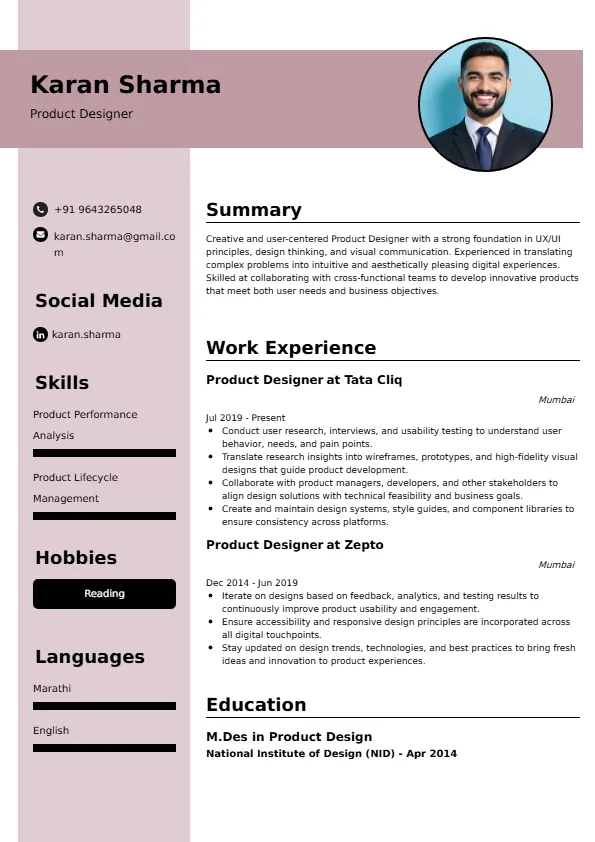
Superbresume.com empowers Product Designers to craft resumes that highlight their human-centered design process and measurable product impact. Our platform offers customizable templates tailored for design roles, emphasizing skills like design thinking facilitation, usability testing, accessibility (WCAG), and contributing to product strategy based on user insights. With ATS-optimized formats, expert-written content suggestions, and real-time resume analysis, we ensure your resume aligns with job descriptions. Showcase your experience in leading design sprints that resolved key user pain points, significantly improving feature adoption metrics, or contributing to a scalable, cross-platform design system with confidence. Superbresume.com helps you create a polished, results-driven resume that grabs hiring managers’ attention and lands interviews.
How to Write a Resume for a Product Designer
Craft a Targeted Summary: Write a 2-3 sentence summary highlighting your expertise in end-to-end product design (UX/UI), proficiency in modern design tools and user research, and success in delivering user-centered features that drive key business and user metrics.
Use Reverse-Chronological Format: List recent product design, UX/UI, or related design roles first, focusing on measurable design impact and process leadership achievements.
Highlight Certifications/Portfolio: Include credentials like Nielsen Norman Group (NN/g) UX Certification, specialized design software training, or relevant degrees (HCI/Design) and prominently feature a link to your design portfolio/case studies to boost credibility.
Quantify Achievements: Use metrics, e.g., “Redesigned the mobile checkout flow based on user testing, resulting in a 15% decrease in cart abandonment rate,” or “Contributed 50+ components to the company’s Design System, reducing design handoff time by 30%,” to show impact.
Incorporate Keywords: Use terms like “UX/UI Design,” “Figma/Sketch/Adobe XD,” “User Research (Qualitative/Quantitative),” “Design Systems,” “Prototyping & Wireframing,” “Usability Testing,” “Design Thinking,” or “A/B Testing (Design)” from job descriptions for ATS.
Detail Technical/Design Skills: List proficiency with specific tools, prototyping software (Framer, Principle), user research platforms (UserTesting), accessibility standards (WCAG), and basic front-end knowledge (HTML/CSS for handoff) in a comprehensive skills section.
Showcase Design Projects: Highlight 3-4 key product features or design challenges, detailing the user problem addressed, the design process used (research, wireframe, prototype), and the quantified user/business outcome.
Emphasize Soft Skills: Include empathy, creativity, strong communication (articulating design rationale), attention to detail (visual fidelity), and cross-functional collaboration (Engineering/PMs).
Keep It Concise: Limit your resume to 1-2 pages, focusing on relevant product design, research, and technical execution experience.
Proofread Thoroughly: Eliminate typos or jargon for a professional document.
Design Systems and Scalability: Focus heavily on expertise creating, documenting, and maintaining a centralized Design System (component library, style guide) to ensure product consistency and enable design/engineering at scale.
User Research and Experimentation: Highlight advanced proficiency planning and executing both qualitative (interviews, usability tests) and quantitative (A/B test setup, survey analysis) research to validate design hypotheses.
Accessibility (A11y) and Inclusive Design: Showcase deep knowledge and adherence to WCAG compliance standards, ensuring all design solutions are accessible to users with disabilities.
Figma/Sketch Mastery and Prototyping: Detail advanced proficiency in current industry-standard tools (Figma preferred) for creating high-fidelity prototypes, managing design files, and preparing specs for developer handoff.
Cross-Functional Strategy: Emphasize involvement in early-stage product discovery, translating business requirements into user stories, and influencing the product roadmap based on user needs.
Metrics-Driven Achievements: Use results like “Successfully reduced user task completion time by 20% by simplifying the navigation flow” or “Led a design sprint that resulted in a 10% increase in conversion rate on a key sign-up page.”
Motion Design and Micro-interactions: Include experience designing intentional micro-interactions and transitions to enhance usability, provide feedback, and improve the perceived quality of the interface.
Collaboration with Engineers (Dev Handoff): Highlight experience using modern handoff tools (e.g., Figma Dev Mode, Zeplin) and collaborating closely with front-end engineers to ensure design fidelity and feasibility.
Choose Superbresume.com to craft a Product Designer resume that stands out in the competitive tech design sector. Our platform offers tailored templates optimized for ATS, ensuring your skills in Figma/Sketch, user research, and measurable UX impact shine. With expert guidance, pre-written content, and real-time feedback, we help you highlight achievements like boosting feature adoption or reducing churn through design. Whether you design mobile apps or enterprise platforms, our tools make it easy to create a polished, results-driven resume. Trust Superbresume.com to showcase your expertise in human-centered design and strategic product development. Start building your career today!
20 Key Skills for a Product Designer Resume
| UX/UI Design (End-to-End) | Figma/Sketch/Adobe XD Mastery |
| User Research (Qualitative/Quantitative) | Prototyping & Wireframing |
| Design Systems & Component Libraries | Usability Testing & Heuristic Evaluation |
| Design Thinking & Sprint Facilitation | A/B Testing & Experimentation Design |
| Accessibility (WCAG) Compliance | Information Architecture (IA) & User Flows |
| Front-End Handoff & Specification (HTML/CSS awareness) | Data Visualization (for Dashboards) |
10 Do’s for a Product Designer Resume
Tailor Your Resume: Customize for the specific platform (e.g., emphasize mobile UX for a mobile job, emphasize enterprise workflow for an enterprise job).
Highlight Certifications/Portfolio: List NN/g certification and include a prominent link to your design portfolio/case studies (mandatory).
Quantify Achievements: Include metrics on conversion rate lift, task completion time reduction, feature adoption increase, or design system efficiency gains.
Use Action Verbs: Start bullet points with verbs like “designed,” “researched,” “prototyped,” “tested,” or “optimized.”
Showcase Design Process: Detail the methodology and the strategic, quantified user/business result of 3-4 key design projects.
Include Soft Skills: Highlight empathy, creativity, strong communication (design rationale), and cross-functional collaboration.
Optimize for ATS: Use standard design section titles and incorporate key tools and design methodology terms.
Keep It Professional: Use a clean, consistent font and a visually appealing, yet simple, layout.
Emphasize Process and Outcomes: Clearly articulate how user research informed the design and how the design drove measurable metrics.
Proofread Thoroughly: Eliminate typos or jargon for a professional document.
10 Don’ts for a Product Designer Resume
Don’t Overload with Jargon: Avoid confusing, internal company or niche design acronyms; use standardized UX/UI terminology.
Don’t Exceed Two Pages: Keep your resume concise; the portfolio is the most critical component.
Don’t Omit Dates: Include employment dates for career context.
Don’t Use Generic Templates: Tailor your resume specifically to the human-centered, data-driven duties of a Product Designer.
Don’t List Irrelevant Skills: Focus on UX/UI, research, prototyping, design systems, and product strategy.
Don’t Skip Metrics: Quantify results wherever possible; user metrics and conversion rates are key.
Don’t Use Complex Formats: Avoid highly stylized elements or confusing graphics.
Don’t Ignore User Research: Include explicit experience conducting both qualitative and quantitative research.
Don’t Include Outdated Experience: Omit non-design or non-UX roles over 15 years old.
Don’t Forget to Update: Refresh for new design system contributions, successful A/B test analysis, or advanced software feature mastery.
5 FAQ's for a Product Designer Resume
Keep it clean and readable. Your portfolio is for flair; your resume is for clarity and ATS (Applicant Tracking System) compatibility.
Use keywords like User Research, Wireframing, High-Fidelity Prototyping, and Usability Testing.
It is mandatory. Ensure the link is clickable and prominently placed at the top.
Mention how you worked with Engineers to ensure feasibility and Product Managers to align with the roadmap.
Yes. List Figma, Sketch, Adobe XD, and any motion or research tools you use.
Get 5x more interviews with our crafted Resumes. We make resumes that land jobs.

Get a Free Customized Cover Letter with Resume Expert Advice
with every resume order placed, you will get a free Customized Cover letter.