Photographer
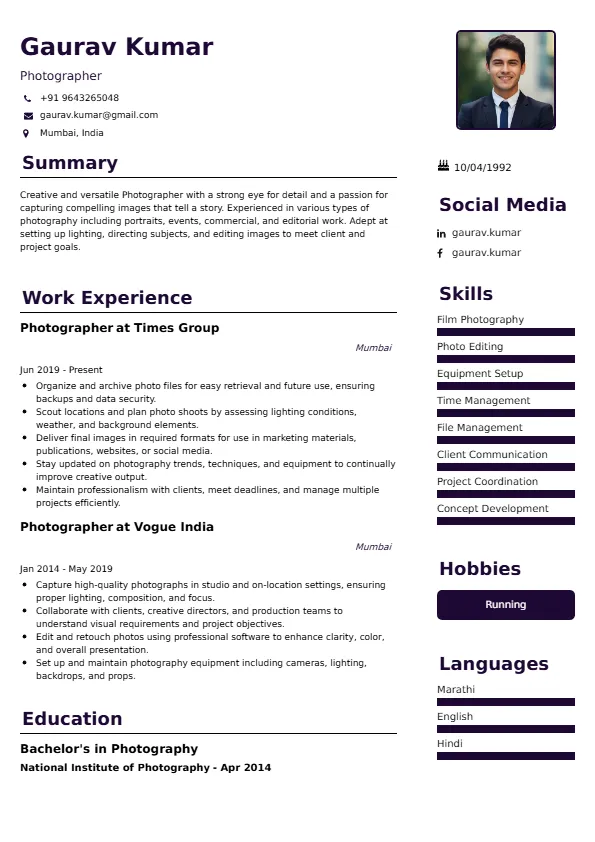
Welcome to our Photographer resume sample page! This expertly crafted resume template is designed to showcase your expertise in conceptualizing, shooting, and producing high-quality images for clients across various specialties (e.g., commercial, editorial, portrait, event), managing studio/equipment, and editing final assets. Whether you work freelance or in-house, this sample highlights key skills like Technical Camera Proficiency, Lighting Techniques (Studio/Natural), Adobe Creative Suite (Post-Production), Client Management, and Portfolio Presentation tailored to meet top creative and media demands. Use this guide to create a polished, results-driven resume that stands out and secures your next career opportunity.Build a Standout Photographer Resume with Superbresume.com
Superbresume.com empowers Photographers to craft resumes that highlight their artistic vision and technical production expertise. Our platform offers customizable templates tailored for creative roles, emphasizing skills like advanced lighting setups (Strobe/LED), tethered shooting, digital asset management (DAM), and post-production workflow (Retouching/Color Grading). With ATS-optimized formats, expert-written content suggestions, and real-time resume analysis, we ensure your resume aligns with job descriptions. Showcase your experience in consistently delivering high-quality images that met client sales/editorial goals, managing complex on-location shoots, or building a successful commercial client base with confidence. Superbresume.com helps you create a polished, results-driven resume that grabs hiring managers’ attention and lands interviews.
How to Write a Resume for a Photographer
Craft a Targeted Summary: Write a 2-3 sentence summary highlighting your expertise in professional photography (specify niche: Commercial, Editorial, Portrait), proficiency in technical execution and post-production, and success in delivering high-quality, conceptual images that meet client objectives.
Use Reverse-Chronological Format: List recent photography roles, long-term freelance contracts, or relevant creative positions first, focusing on measurable client success and technical achievements.
Highlight Certifications/Portfolio: Include credentials like Photography Certification/Degree (BFA/MFA), specialized lighting/studio training, or feature a link to your online photography portfolio to boost credibility.
Quantify Achievements: Use metrics, e.g., “Completed 150+ commercial photo shoots annually, delivering 5,000+ final retouched assets on time,” or “Images used in a national ad campaign that resulted in a 10% increase in click-through rate (CTR),” to show impact.
Incorporate Keywords: Use terms like “Technical Camera Proficiency (DSLR/Mirrorless),” “Studio & Location Lighting,” “Post-Production Workflow (Retouching/Grading),” “Client Brief Adherence,” “Digital Asset Management (DAM),” “Visual Storytelling,” or “Specialty Photography (e.g., Portrait/Product)” from job roles for ATS.
Detail Technical Skills: List proficiency with specific camera systems (Canon/Nikon/Sony), lighting equipment (Profoto/Godox), post-production software (Lightroom/Capture One), tethering software, and file formats (RAW, TIFF, JPEG) in a comprehensive skills section.
Showcase Projects/Clients: Highlight 3-4 key shoots or clients, detailing the purpose (e.g., e-commerce launch, magazine feature), the technical challenge solved (e.g., complex lighting setup, tight deadline), and the final delivery platform.
Emphasize Soft Skills: Include creative vision, technical precision, strong client communication, time management, organizational excellence (equipment/files), and attention to detail (post-production).
Keep It Concise: Limit your resume to 1-2 pages, focusing on relevant photography, technical expertise, and commercial/creative experience.
Proofread Thoroughly: Eliminate typos or jargon for a professional document.
Advanced Lighting Techniques and Control: Focus on expertise designing and executing complex multi-light setups (strobes, continuous LED) in both studio and challenging on-location environments, mastering light shaping/metering.
Digital Asset Management (DAM) and Workflow: Highlight deep proficiency organizing, tagging, backing up, and archiving large volumes of high-resolution RAW files, ensuring efficient retrieval and secure storage.
Tethered Shooting and Live Client Review: Showcase experience shooting tethered to a computer for real-time review with clients and art directors, accelerating feedback cycles on set.
Video/Motion Integration: Include proficiency shooting and editing short-form video (e.g., social media reels, behind-the-scenes) to complement still photography packages, demonstrating multi-media versatility.
Post-Production Speed and Consistency: Emphasize expertise in efficient batch processing, color grading, and high-end retouching workflows (Lightroom/Capture One/Photoshop) to deliver final images that adhere to consistent brand style and quality.
Metrics-Driven Achievements: Use results like “Successfully managed a budget of $X for equipment rentals and assistants per shoot” or “Increased client repeat business by 25% through superior project management and delivery.”
Client Brief Adherence and Concepting: Highlight strong communication skills, effectively translating a client's often abstract creative brief into a detailed technical and artistic plan.
Aerial and Drone Photography (if certified): If FAA certified, include expertise in specialized aerial photography techniques for commercial or real estate purposes.
Choose Superbresume.com to craft a Photographer resume that stands out in the competitive creative and commercial sector. Our platform offers tailored templates optimized for ATS, ensuring your skills in technical shooting, lighting mastery, and post-production workflow shine. With expert guidance, pre-written content, and real-time feedback, we help you highlight achievements like managing complex on-location shoots or achieving high client satisfaction. Whether you specialize in commercial, editorial, or portrait photography, our tools make it easy to create a polished, results-driven resume. Trust Superbresume.com to showcase your expertise in reliable, technically proficient, and visually compelling image creation. Start building your career today!
20 Key Skills for a Photographer Resume
| Technical Camera Proficiency (Exposure/Focus) | Studio & Location Lighting (Strobe, Continuous LED) |
| Post-Production Workflow (Lightroom/Capture One) | Adobe Photoshop (Retouching/Compositing) |
| Client Management & Communication | Digital Asset Management (DAM) & Archiving |
| Tethered Shooting & Workflow | Concepting & Visual Storytelling |
| Budget Management (Shoot Expenses) | Advanced Editing & Color Grading |
10 Do’s for a Photographer Resume
Tailor Your Resume: Customize for the specific niche (e.g., emphasize commercial product photography, emphasize documentary/editorial work).
Highlight Certifications/Portfolio: List relevant degrees/certifications and, most importantly, include a prominent link to your online portfolio.
Quantify Achievements: Include metrics on client volume, shoot volume, budget size managed, or measurable sales/editorial success of the images.
Use Action Verbs: Start bullet points with verbs like “shot,” “conceptualized,” “managed,” “edited,” or “produced.”
Showcase Technical Mastery: Detail the specific lighting setups or complex technical solutions used to achieve creative goals in 3-4 key shoots.
Include Soft Skills: Highlight creative vision, technical precision, strong communication, and client focus.
Optimize for ATS: Use standard creative section titles and incorporate key camera, lighting, and software terms.
Keep It Professional: Use a clean, consistent font and professional layout.
Emphasize Technical and Commercial Skills: Clearly articulate expertise in the technical execution required for professional, client-driven results.
Proofread Thoroughly: Eliminate typos or jargon for a professional document.
10 Don’ts for a Photographer Resume
Don’t Overload with Jargon: Avoid confusing, internal studio or project acronyms; use standardized photography and creative terminology.
Don’t Exceed Two Pages: Keep your resume concise; the portfolio is the core of the application.
Don’t Omit Dates: Include employment dates and project completion dates for career context.
Don’t Use Generic Templates: Tailor your resume specifically to the specialized technical and artistic duties of a Photographer.
Don’t List Irrelevant Skills: Focus on shooting, lighting, post-production, client management, and technical equipment.
Don’t Skip Metrics: Quantify results wherever possible; link achievements to commercial success, budget control, or volume.
Don’t Use Complex Formats: Avoid highly stylized elements or confusing graphics.
Don’t Ignore Post-Production Workflow: Include explicit experience in editing, retouching, and file management (DAM).
Don’t Include Outdated Experience: Omit non-photography or irrelevant jobs over 15 years old.
Don’t Forget to Update: Refresh for new camera system mastery, successful commercial shoots, or advanced lighting training.
5 FAQ's for a Photographer Resume
Yes. Use a site like Adobe Portfolio, Pixieset, or a personal domain. No portfolio usually means no interview.
Mention your primary systems (e.g., Sony Alpha, Canon EOS R, Phase One) and proficiency in studio lighting and tethered shooting.
Adobe Lightroom, Photoshop, and Capture One.
"Produced product assets for an e-commerce brand that resulted in a 20% increase in online conversion rates."
Yes. "Coordinated logistics, talent, and assistants for multi-day commercial shoots on-location."
Get 5x more interviews with our crafted Resumes. We make resumes that land jobs.

Get a Free Customized Cover Letter with Resume Expert Advice
with every resume order placed, you will get a free Customized Cover letter.