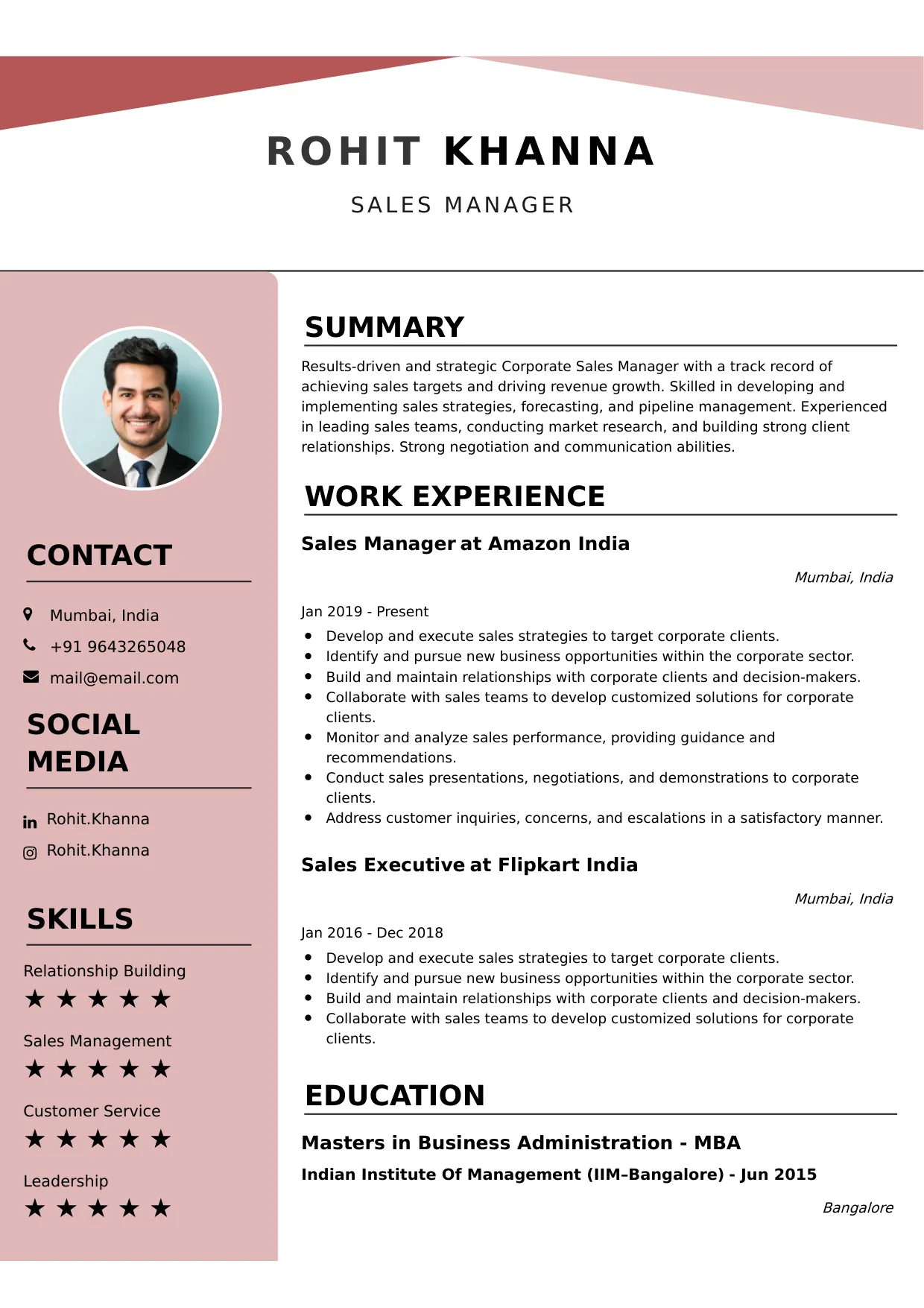
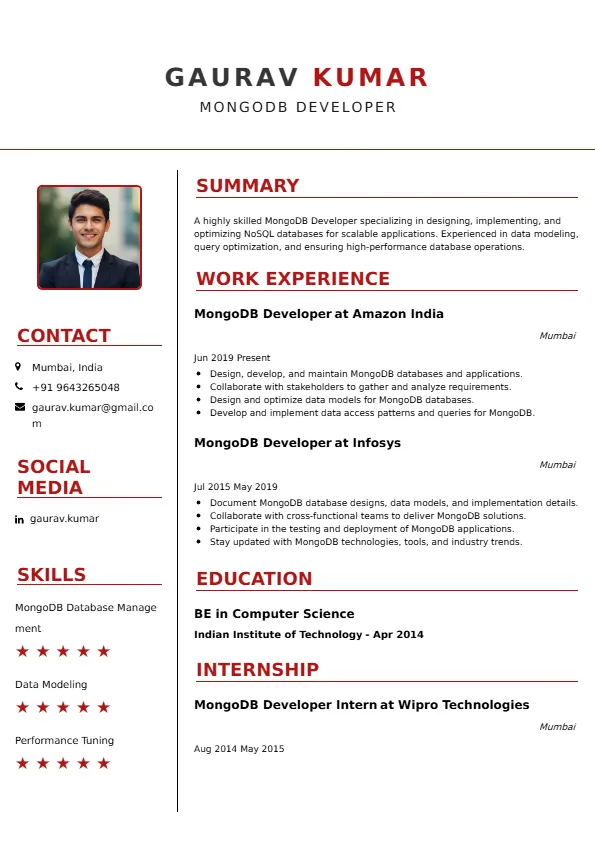
MongoDB Developer
Welcome to our MongoDB Developer resume sample page! This expertly crafted resume template is designed to showcase your expertise in designing, implementing, and optimizing NoSQL database architectures, developing complex queries using the MongoDB Query Language (MQL), and integrating MongoDB with scalable application backends. Whether you're an entry-level candidate or a seasoned professional, this sample highlights key skills like Schema Design (Document Modeling), MQL/Aggregation Framework, Replication/Sharding (Scalability), Node.js/Python Integration, and Database Performance Tuning tailored to meet top tech and data platform demands. Use this guide to create a compelling resume that stands out and secures your next career opportunity.
How to Write a Resume for a MongoDB Developer
Craft a Targeted Summary: Write a 2-3 sentence summary highlighting your expertise in full-cycle MongoDB development and NoSQL architecture, proficiency in MQL and the Aggregation Framework, and success in designing and scaling databases for high-performance applications.
Use Reverse-Chronological Format: List recent MongoDB, back-end development, or NoSQL DBA roles first, focusing on measurable scalability and performance achievements.
Highlight Certifications/Training: Include credentials like MongoDB Certified Developer Associate, specialized NoSQL database certifications, or relevant back-end programming certifications (e.g., Node.js) to boost credibility.
Quantify Achievements: Use metrics, e.g., “Optimized 10+ complex MQL aggregation queries, reducing read latency by 40% and supporting real-time dashboarding,” or “Designed and implemented a sharded cluster that scaled to support 1 million daily transactions with 99.99% availability,” to show impact.
Incorporate Keywords: Use terms like “MongoDB Query Language (MQL),” “Schema Design (Document Modeling),” “Aggregation Framework,” “Replication & Sharding,” “Database Performance Tuning (Indexing),” “NoSQL Architecture,” or “MongoDB Atlas/Cloud” from job roles for ATS.
Detail Technical Skills: List proficiency with specific MongoDB tools (Compass, mongosh), cluster technologies (Replica Sets, Sharding), programming languages (Node.js, Python), cloud platforms, and data modeling (Document/Embedded/Reference) in a comprehensive skills section.
Showcase Database Projects: Highlight 3-4 key schema designs, aggregation pipelines, or scaling projects, detailing the collection design, the technical challenge solved (e.g., query latency, write performance), and the measurable application/user outcome.
Emphasize Soft Skills: Include systematic problem-solving, analytical rigor (query tuning), attention to detail (data integrity), and collaboration (with back-end engineers/data scientists).
Keep It Concise: Limit your resume to 1-2 pages, focusing on relevant MongoDB development, scaling, and optimization experience.
Proofread Thoroughly: Eliminate typos or jargon for a professional document.
Aggregation Framework Mastery: Focus heavily on expertise utilizing the powerful MongoDB Aggregation Framework for complex ETL processes, reporting, and real-time analytics within the database, reducing reliance on external tools.
Scalability and Sharding Implementation: Highlight deep experience designing the shard key, configuring sharding across multiple nodes, and managing the overall horizontal scalability of the cluster for high-volume data growth.
Cloud Database Management (MongoDB Atlas): Showcase proficiency managing and optimizing MongoDB deployments using the Atlas cloud platform, including monitoring, backup, and security features.
Schema Design and Document Modeling: Detail expertise in choosing optimal document models (embedded vs. normalized) for specific application read/write patterns to minimize query latency and redundancy.
Performance Tuning (Indexing and Query Plans): Emphasize using tools like explain() to analyze query plans, design efficient indexes (compound, text, geospatial), and optimize the memory usage of operations.
Metrics-Driven Achievements: Use results like “Implemented an indexing strategy that reduced the latency of the 5 most frequent queries by 70%” or “Successfully migrated a relational database schema to a flexible document model for a new microservice.”
Data Integration and Change Streams: Include experience utilizing MongoDB Change Streams for real-time data synchronization with other systems or microservices.
Full-Text Search (Atlas Search/Lucene): Highlight proficiency utilizing the built-in search capabilities (e.g., Atlas Search) for application search functionality, moving beyond basic MQL lookups.
20 Key Skills for a MongoDB Developer Resume
| MongoDB Query Language (MQL) | Aggregation Framework Mastery |
| Schema Design & Document Modeling (NoSQL) | Indexing Strategies & Performance Tuning |
| Replication (Replica Sets) & High Availability (HA) | Sharding Implementation & Management |
| Node.js/Python Integration (Driver Proficiency) | MongoDB Atlas/Cloud Management |
| Data Integration (Change Streams) | Database Security & Access Control |
10 Do’s for a MongoDB Developer Resume
Tailor Your Resume: Customize for the specific deployment environment (e.g., emphasis on Atlas/Cloud management, emphasis on sharding/scalability).
Highlight Certifications/Training: List MongoDB Certified Developer certification and advanced query/aggregation training prominently.
Quantify Achievements: Include metrics on query latency reduction, throughput (transactions/sec), data volume managed (TB/PB), or efficiency gains from aggregation pipelines.
Use Action Verbs: Start bullet points with verbs like “designed,” “optimized,” “implemented,” “scaled,” or “developed.”
Showcase Database Projects: Detail the technical stack, the schema design choice, and the measurable performance/scalability outcome for 3-4 key projects.
Include Soft Skills: Highlight analytical rigor, systematic problem-solving (query tuning), and collaboration with back-end application developers.
Optimize for ATS: Use standard engineering/data section titles and incorporate key MQL, framework, and scaling terms.
Keep It Professional: Use a clean, consistent font and engineering layout.
Emphasize MQL and Scaling: Clearly articulate expertise in complex querying (Aggregation) and managing high-volume data growth (Sharding).
Proofread Thoroughly: Eliminate typos or jargon for a professional document.
10 Don’ts for a MongoDB Developer Resume
Don’t Overload with Jargon: Avoid confusing, internal company acronyms; use standardized MongoDB and NoSQL terminology.
Don’t Exceed Two Pages: Keep your resume concise, focusing on high-impact MongoDB development, scaling, and optimization achievements.
Don’t Omit Dates: Include employment dates for career context.
Don’t Use Generic Templates: Tailor your resume specifically to the schema-flexible, high-scaling duties of a MongoDB Developer.
Don’t List Irrelevant Skills: Focus on MQL, schema design, scaling (Replication/Sharding), indexing, and performance tuning.
Don’t Skip Metrics: Quantify results wherever possible; latency, throughput, and data volume are critical metrics.
Don’t Use Complex Formats: Avoid highly stylized elements or confusing graphics.
Don’t Ignore Performance Tuning: Include explicit experience analyzing query plans and optimizing indexes.
Don’t Include Outdated Experience: Omit non-NoSQL or irrelevant database jobs over 15 years old.
Don’t Forget to Update: Refresh for new certification mastery, successful sharding implementations, or advanced Atlas feature utilization.
5 FAQs for a MongoDB Developer Resume
Prioritize MQL and Aggregation Framework mastery, schema design (document modeling), indexing/performance tuning, and sharding/replication for scalability.
Use standard engineering/data section titles, avoid graphics, and include keywords like “Aggregation Framework,” “Sharding,” and “MongoDB Atlas.”
Yes, listing proficiency with drivers (Node.js/Python) that interact with MongoDB is highly valuable.
Detail the initial query latency, the optimization technique used (e.g., index creation, aggregation pipeline refactor), and the resulting quantified speed improvement.
Use a reverse-chronological format to emphasize your most recent, high-impact MongoDB development and scaling achievements.
Get 5x more interviews with our crafted Resumes. We make resumes that land jobs.

Get a Free Customized Cover Letter with Resume Expert Advice
with every resume order placed, you will get a free Customized Cover letter.