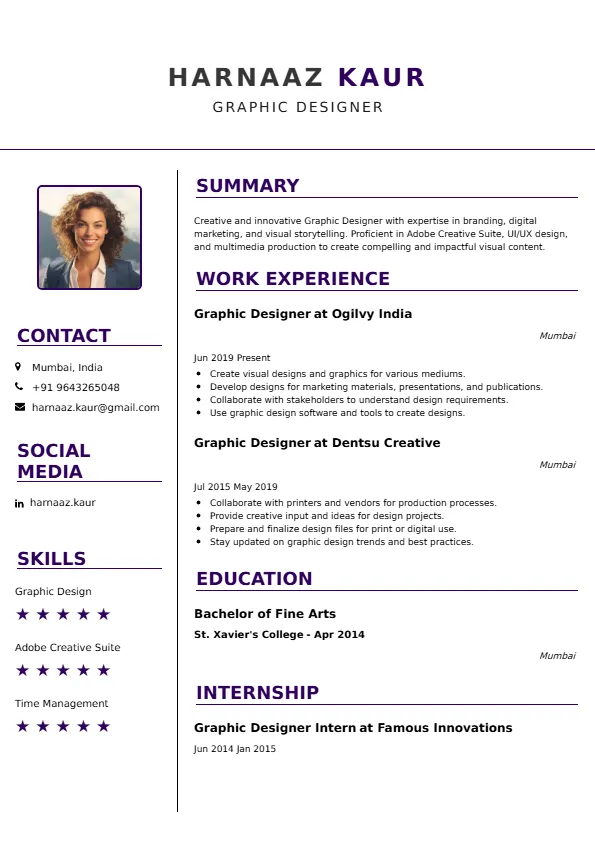
Graphic Designer
Welcome to our Graphic Designer resume sample page! This expertly crafted resume template is designed to showcase your expertise in creating compelling visual content, adhering to brand guidelines, mastering design software, and delivering print and digital assets for marketing, advertising, and internal communication. Whether you're an entry-level candidate or a seasoned professional, this sample highlights key skills like Adobe Creative Suite (Photoshop, Illustrator, InDesign), typography, layout design, branding, and cross-functional collaboration tailored to meet top agency and corporate demands. Use this guide to create a compelling resume that stands out and secures your next career opportunity.Build a Standout Graphic Designer Resume with Superbresume.com
Superbresume.com empowers Graphic Designers to craft resumes that highlight their creative talent and visual communication expertise. Our platform offers customizable templates tailored for design roles, emphasizing skills like print production (pre-press), UI/UX awareness, motion graphics (After Effects), and design for web/social media. With ATS-optimized formats, expert-written content suggestions, and real-time resume analysis, we ensure your resume aligns with job descriptions. Showcase your experience in launching successful marketing campaigns, increasing brand engagement, or contributing to a robust visual identity system with confidence. Superbresume.com helps you create a polished, results-driven resume that grabs hiring managers’ attention and lands interviews.
How to Write a Resume for a Graphic Designer
Craft a Targeted Summary: Write a 2-3 sentence summary highlighting your expertise in visual communication and graphic design, proficiency in the Adobe Creative Suite, and success in delivering creative solutions that meet brand objectives and drive measurable results.
Use Reverse-Chronological Format: List recent design roles, freelance projects, or relevant creative positions first, focusing on visual impact and project scope.
Highlight Certifications/Portfolio: Include credentials like Adobe Certified Professional (ACP), specialized design training, or relevant degrees (BFA/MFA) and prominently feature a link to your online design portfolio to boost credibility.
Quantify Achievements: Use metrics, e.g., “Designed marketing collateral used in a campaign that increased sales revenue by 20%,” or “Managed the visual brand identity for 5 product launches, ensuring 100% adherence to style guides,” to show impact.
Incorporate Keywords: Use terms like “Adobe Creative Suite (Photoshop/Illustrator/InDesign),” “Typography & Layout,” “Brand Identity,” “Digital/Print Design,” “Visual Communication,” “Web/Social Media Assets,” or “Design Systems” from job roles for ATS.
Detail Technical Skills: List proficiency with specific software, coding knowledge (HTML/CSS if applicable), print production processes, color theory, and project management tools in a comprehensive skills section.
Showcase Design Projects: Highlight 3-4 key design projects (e.g., logo redesign, annual report, digital ad campaign), detailing the client/purpose, the visual challenge solved, and the final delivery platform.
Emphasize Soft Skills: Include creativity, aesthetic sense, attention to detail (pre-press), client communication, and collaboration (with marketers/developers).
Keep It Concise: Limit your resume to 1-2 pages, focusing on relevant visual design, software mastery, and project experience.
Proofread Thoroughly: Eliminate typos or jargon for a professional document.
Motion Graphics and Video Assets: Focus on expertise using After Effects or similar tools to create animated graphics, explainers, or video assets for social media and web.
Design Systems and Component Libraries: Highlight experience contributing to or adhering to a scalable design system (e.g., creating style guides, component specifications) for digital products.
UX/UI Awareness (for Digital Designers): Showcase a strong understanding of user-centered design principles, accessibility (WCAG), and creating assets optimized for web and mobile interfaces.
Data Visualization Design: Detail experience designing clear, aesthetically pleasing charts, graphs, and infographics that effectively communicate complex data stories.
Branding and Identity Development: Emphasize expertise in logo design, color palette definition, typography selection, and creating comprehensive brand guidelines.
Metrics-Driven Achievements: Use results like “Redesigned company presentation template, increasing executive satisfaction by 25%” or “Designed social media ads that achieved a 5% higher click-through rate (CTR).”
AI/Generative Tools (Ethical Use): Include foundational knowledge or ethical experience utilizing AI tools (e.g., Midjourney, Firefly) to expedite concepting or design production, while maintaining creative control.
Print Production Rigor: Highlight meticulous attention to pre-press, bleed, resolution, and color modes (CMYK) for flawless physical output.
Choose Superbresume.com to craft a Graphic Designer resume that stands out in the competitive creative industry. Our platform offers tailored templates optimized for ATS, ensuring your skills in Adobe Creative Suite, branding, and visual communication shine. With expert guidance, pre-written content, and real-time feedback, we help you highlight achievements like boosting campaign performance or contributing to a cohesive brand identity. Whether you focus on print, digital, or motion, our tools make it easy to create a polished, results-driven resume. Trust Superbresume.com to showcase your expertise in translating concepts into compelling visual assets. Start building your career today!
20 Key Skills for a Graphic Designer Resume
| Adobe Creative Suite (Photoshop, Illustrator, InDesign) | Brand Identity & Style Guide Management |
| Typography & Visual Hierarchy | Layout Design (Print & Digital) |
| Digital Asset Creation (Web, Social) | Print Production & Pre-Press Expertise (CMYK) |
| Logo Design & Branding | Motion Graphics (After Effects, if applicable) |
| Data Visualization & Infographics | UI/UX Principles Awareness |
| Color Theory & Application | Vector Graphics & Raster Editing |
| Client/Stakeholder Communication | Project Management (Design Workflow) |
| Version Control (Assets) | Creative Concept Development |
| Attention to Detail (Pixel Perfection) | Time Management & Deadlines |
10 Do’s for a Graphic Designer Resume
Tailor Your Resume: Customize for the primary medium (e.g., emphasize Print/Packaging or Digital/Web Design) and the industry's aesthetic.
Highlight Certifications/Portfolio: List Adobe Certified Professional status and, most importantly, include a prominent link to your online design portfolio.
Quantify Achievements: Include metrics on campaign performance impact, project volume managed, or efficiency/cost savings achieved through design.
Use Action Verbs: Start bullet points with verbs like “designed,” “created,” “developed,” “executed,” or “managed.”
Showcase Design Projects: Detail 3-4 key projects, emphasizing the challenge, the creative solution, and the final measured impact.
Include Soft Skills: Highlight creativity, aesthetic sense, attention to technical detail (print specs, web resolution), and client collaboration.
Optimize for ATS: Use standard design section titles and incorporate key software and design terminology.
Keep It Professional: Use a clean, consistent font and a visually appealing, yet simple, layout.
Emphasize Software Mastery: Clearly list proficiency with the core Adobe Creative Suite applications.
Proofread Carefully: Ensure no typos or errors; the resume itself is a design artifact.
10 Don’ts for a Graphic Designer Resume
Don’t Overload with Jargon: Avoid confusing, internal company or niche design acronyms; use standardized industry terminology.
Don’t Exceed Two Pages: Keep your resume concise; let your portfolio do the heavy lifting for visual details.
Don’t Omit Dates: Include employment dates and project completion dates for career context.
Don’t Use Generic Templates: Tailor your resume specifically to the creative and technical duties of a Graphic Designer.
Don’t List Irrelevant Skills: Focus on design software, theory, branding, typography, and production processes.
Don’t Skip Metrics: Quantify results wherever possible; link design work to business goals (sales, engagement, brand awareness).
Don’t Use Complex Formats: Avoid highly stylized graphics that might confuse an ATS; prioritize clarity and scannability.
Don’t Ignore Branding: Include explicit experience working within or creating visual brand standards.
Don’t Include Outdated Experience: Omit non-design or irrelevant jobs over 15 years old.
Don’t Forget to Update: Refresh for new software mastery, successful brand launches, or advanced motion graphics skills.
5 FAQs for a Graphic Designer Resume
Prioritize mastery of the Adobe Creative Suite, typography/layout design, brand identity creation, and proficiency in both print and digital design processes.
Use standard design section titles, avoid excessive graphics on the resume itself, and include keywords like “InDesign,” “Branding,” and “Visual Hierarchy.”
Yes, a link to your online portfolio (e.g., Behance, personal site) is mandatory for this role and should be clearly visible.
Detail a process change (e.g., creating a component library, using templates) that resulted in a quantified reduction in design time for repeat assets.
Use a reverse-chronological format to emphasize your most recent, high-impact design projects and software mastery.
Get 5x more interviews with our crafted Resumes. We make resumes that land jobs.

Get a Free Customized Cover Letter with Resume Expert Advice
with every resume order placed, you will get a free Customized Cover letter.