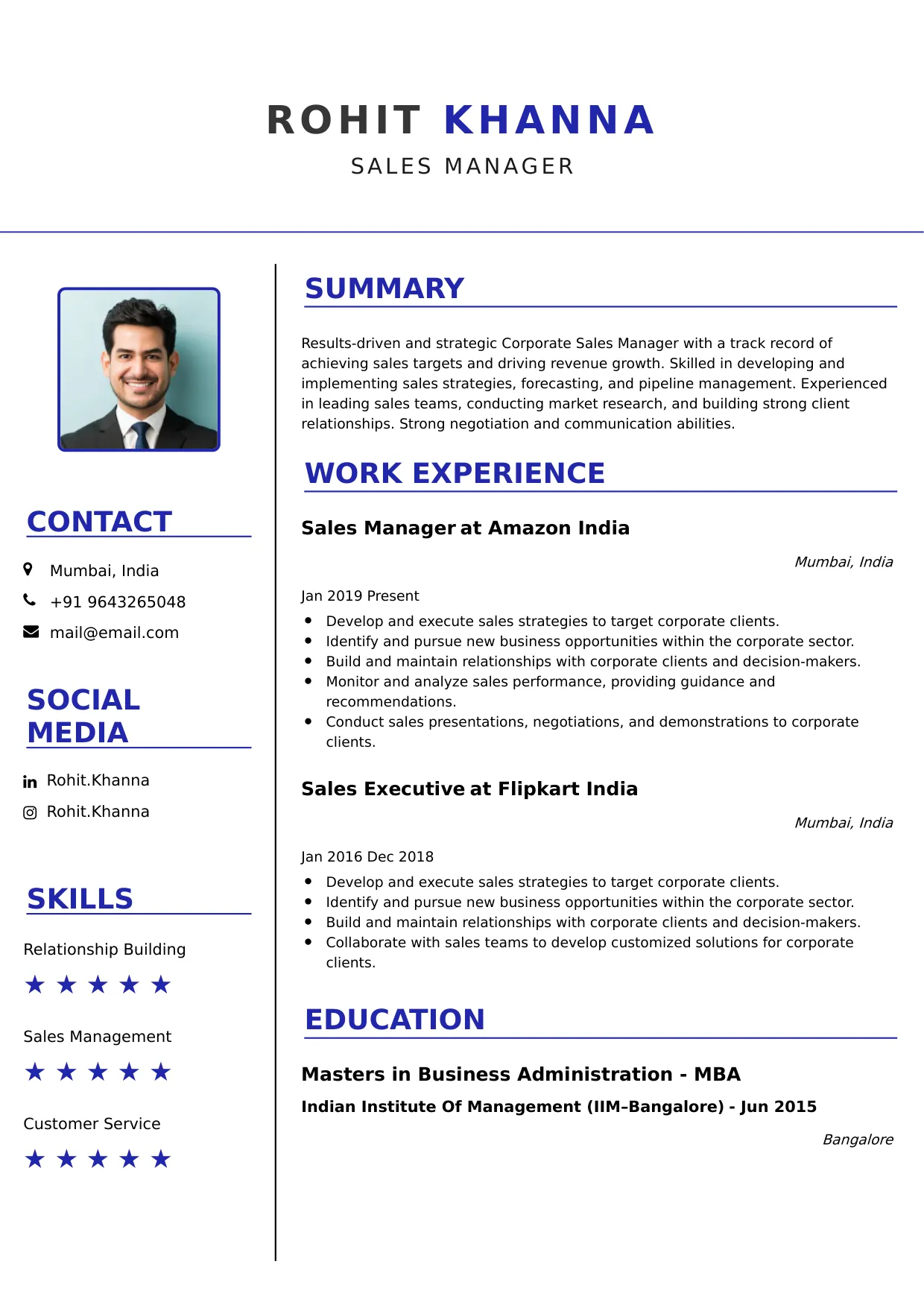
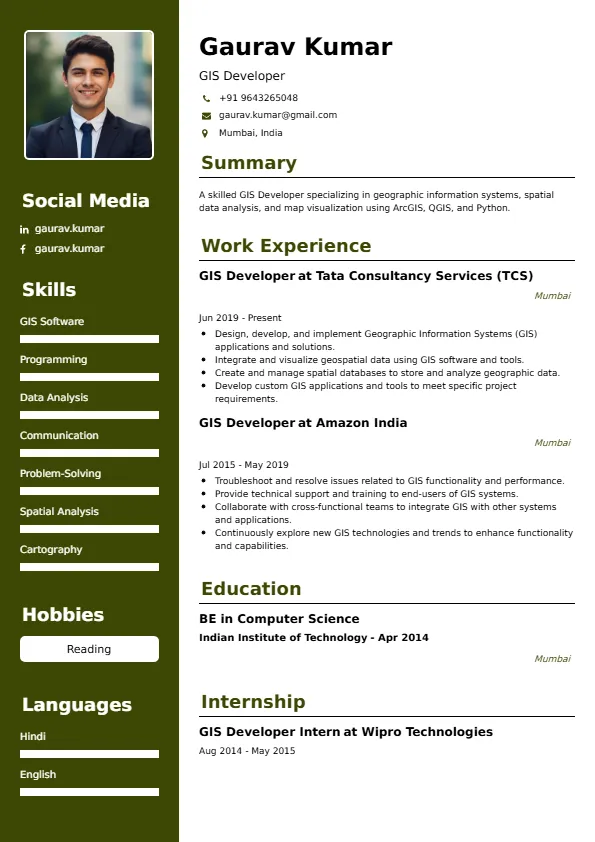
GIS Developer
Welcome to our GIS Developer resume sample page! This expertly crafted resume template is designed to showcase your expertise in building and customizing spatial data applications, developing geoprocessing tools, managing geospatial databases, and integrating GIS functionality into web platforms. Whether you're an entry-level candidate or a seasoned professional, this sample highlights key skills like ArcGIS API/SDK, Python (ArcPy), spatial database management (PostGIS), web mapping frameworks (Leaflet/OpenLayers), and spatial analysis tailored to meet top government, utility, and tech demands. Use this guide to create a compelling resume that stands out and secures your next career opportunity.Build a Standout GIS Developer Resume with Superbresume.com
Superbresume.com empowers GIS Developers to craft resumes that highlight their geospatial programming and application integration expertise. Our platform offers customizable templates tailored for spatial technology roles, emphasizing skills like full-stack web GIS development, REST API development (for spatial data), cloud geospatial services, and advanced analytical modeling. With ATS-optimized formats, expert-written content suggestions, and real-time resume analysis, we ensure your resume aligns with job descriptions. Showcase your experience in launching high-performance web mapping applications, automating complex spatial analysis workflows, or managing multi-terabyte geospatial databases with confidence. Superbresume.com helps you create a polished, results-driven resume that grabs hiring managers’ attention and lands interviews.
How to Write a Resume for a GIS Developer
Craft a Targeted Summary: Write a 2-3 sentence summary highlighting your expertise in full-stack geospatial application development, proficiency in Python (ArcPy) and web mapping frameworks, and success in building scalable, data-driven solutions for spatial analysis and visualization.
Use Reverse-Chronological Format: List recent GIS development, geospatial engineering, or software development roles first, focusing on measurable application delivery and spatial analysis achievements.
Highlight Certifications/Portfolio: Include credentials like Esri ArcGIS Developer Certification, specialized cloud/database certifications (e.g., AWS Geo), or feature a GitHub/Portfolio link showcasing code/live web maps to boost credibility.
Quantify Achievements: Use metrics, e.g., “Developed a custom web GIS application utilized by 500 internal users for infrastructure planning, reducing planning time by 20%,” or “Automated 15 complex geoprocessing models using ArcPy, saving 40 hours of manual work monthly,” to show impact.
Incorporate Keywords: Use terms like “Python (ArcPy),” “Web GIS Development,” “ArcGIS API/SDK,” “Spatial Database (PostGIS/SQL Server),” “Geoprocessing,” “Web Mapping (Leaflet/OpenLayers),” “REST API (Spatial),” or “Geospatial Analysis” from job descriptions for ATS.
Detail Technical Skills: List proficiency with specific software (ArcGIS Pro, QGIS), programming languages (Python, JavaScript, SQL), spatial databases, web frameworks (React, Node.js), and cloud geospatial services in a comprehensive skills section.
Showcase Development Projects: Highlight 3-4 key web mapping applications, geoprocessing tools, or database integrations built, detailing the technology stack, the spatial problem solved, and the measurable efficiency/user outcome.
Emphasize Soft Skills: Include analytical problem-solving, attention to detail (data integrity/map accuracy), collaboration (with analysts/users), and systems thinking (data flow).
Keep It Concise: Limit your resume to 1-2 pages, focusing on relevant geospatial development, database, and application experience.
Proofread Thoroughly: Eliminate typos or jargon for a professional document.
Cloud Geospatial Services: Focus on expertise utilizing and integrating cloud-native geospatial services (e.g., AWS Location Services, Google Earth Engine, ArcGIS Online/Portal) for scalable solutions.
Full-Stack Web GIS Development: Highlight proficiency in both back-end (spatial databases, REST APIs) and front-end (JavaScript libraries like Leaflet, Mapbox GL JS) development for complete web mapping applications.
Geospatial Data Engineering: Showcase expertise managing high-volume vector and raster data, optimizing ETL/ELT pipelines for spatial data, and utilizing tools like FME or GDAL.
Python for Automation (ArcPy, GDAL): Emphasize advanced scripting skills in Python for automating complex geoprocessing tasks, report generation, and data cleaning/validation.
3D Visualization and Digital Twins: Include experience developing interactive 3D web scenes, integrating point cloud data, or contributing to digital twin applications using geospatial data.
Metrics-Driven Achievements: Use results like “Implemented a spatial query that reduced analysis time from 5 minutes to 10 seconds” or “Managed the migration of 2TB of spatial data to a PostGIS enterprise database.”
Real-Time Location Services: Detail experience integrating real-time telemetry/IoT data into the GIS platform for live monitoring and decision support.
Big Data Geospatial Processing: Highlight familiarity with distributed processing frameworks (e.g., Spark, Hadoop) optimized for massive geospatial datasets.
Choose Superbresume.com to craft a GIS Developer resume that stands out in the specialized geospatial technology field. Our platform offers tailored templates optimized for ATS, ensuring your skills in Python/ArcPy, spatial databases, and web mapping APIs shine. With expert guidance, pre-written content, and real-time feedback, we help you highlight achievements like automating spatial analysis or building high-performance mapping applications. Whether you focus on utility planning or environmental modeling, our tools make it easy to create a polished, results-driven resume. Trust Superbresume.com to showcase your expertise in engineering the location intelligence that drives strategic decisions. Start building your career today!
20 Key Skills for a GIS Developer Resume
| Python Programming (ArcPy/GeoPandas) | Web Mapping (Leaflet, OpenLayers, Mapbox GL JS) |
| Spatial Database Management (PostGIS, SQL Server) | ArcGIS API/SDK (JavaScript, Python) |
| Geoprocessing & Spatial Analysis | REST API Development (Geospatial Data) |
| ArcGIS Pro/Enterprise/Online | JavaScript & Front-End Frameworks (React) |
| Cloud Geospatial Services (AWS/Google) | Data Visualization (Maps, Dashboards) |
| GDAL/FME (Data Transformation) | SQL (Spatial Queries) |
| ETL/Data Pipeline Optimization (Geospatial) | 3D Visualization (ArcGIS Scene) |
| Requirements Gathering & Scoping | Version Control (Git) |
| Problem-Solving (Geospatial) | Data Integrity & Accuracy |
10 Do’s for a GIS Developer Resume
Tailor Your Resume: Customize for the specific industry (e.g., water utility, city planning, defense) and the primary platform used (Esri or open-source).
Highlight Certifications/Portfolio: List Esri certifications and include a GitHub/live web map portfolio link prominently.
Quantify Achievements: Include metrics on efficiency gains from automation, volume of data managed, or number of users/departments relying on your applications.
Use Action Verbs: Start bullet points with verbs like “developed,” “automated,” “integrated,” “optimized,” or “designed.”
Showcase Application Projects: Detail the technical stack, the spatial problem solved, and the measurable business/user outcome for key applications.
Include Soft Skills: Highlight analytical rigor, systems thinking (data flow), and strong collaboration with GIS Analysts and end-users.
Optimize for ATS: Use standard engineering section titles and incorporate key GIS, programming, and database terms.
Keep It Professional: Use a clean, consistent font and engineering layout.
Emphasize Programming (Python/JS): Clearly state proficiency in the languages used for both scripting (ArcPy) and web development (JavaScript).
Proofread Carefully: Ensure no typos or errors in software names, spatial terminology, or metrics.
10 Don’ts for a GIS Developer Resume
Don’t Overload with Jargon: Avoid confusing, internal company acronyms; use standardized GIS, programming, and database terminology.
Don’t Exceed Two Pages: Keep your resume concise, focusing on high-impact geospatial development and system achievements.
Don’t Omit Dates: Include employment dates for career context.
Don’t Use Generic Templates: Tailor your resume specifically to the programming and spatial analysis duties of a GIS Developer.
Don’t List Irrelevant Skills: Focus on GIS software, spatial databases, programming, web mapping, and data automation.
Don’t Skip Metrics: Quantify results wherever possible; link development work to efficiency gains, user base, or data volume.
Don’t Use Complex Formats: Avoid highly stylized elements or confusing graphics.
Don’t Ignore Database Skills: Include explicit experience managing and querying spatial data in PostGIS or SQL Server.
Don’t Include Outdated Experience: Omit non-GIS or non-development jobs over 15 years old.
Don’t Forget to Update: Refresh for new Esri platform versions, successful web map launches, or advanced spatial data engineering skills.
5 FAQ's for a GIS Developer Resume
Prioritize Python (ArcPy/GeoPandas), JavaScript (Leaflet/OpenLayers), and SQL (PostGIS).
Yes. Provide a link to a GitHub repository or a web-based map gallery showcasing your spatial applications.
Focus on "Spatial Database Management," specifically mentioning "PostGIS," "SQL Server Spatial," or "Oracle Spatial."
Yes, an Esri Technical Certification is highly recognized by government and utility sectors.
Describe the real-world impact: "Developed an automated script that reduced flood risk analysis time from 3 days to 4 hours."
Get 5x more interviews with our crafted Resumes. We make resumes that land jobs.

Get a Free Customized Cover Letter with Resume Expert Advice
with every resume order placed, you will get a free Customized Cover letter.