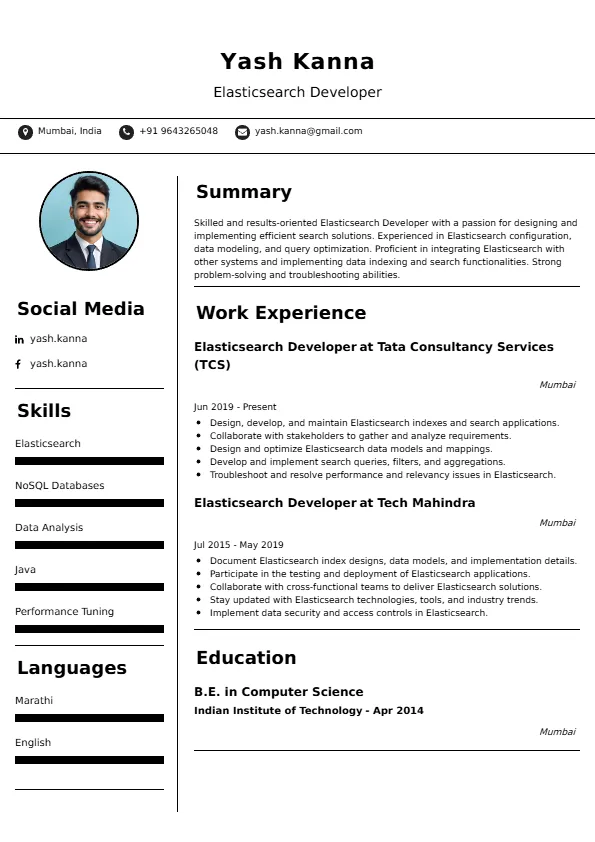
Elasticsearch Developer
Welcome to our Elasticsearch Developer resume sample page! This expertly crafted resume template is designed to showcase your expertise in designing, developing, and optimizing highly scalable search and analytics solutions using the Elastic Stack (Elasticsearch, Logstash, Kibana). Whether you're an entry-level candidate or a seasoned professional, this sample highlights key skills like cluster management, query optimization (DSL), data indexing, security, and integration with modern microservices architectures tailored to meet top tech and data platform demands. Use this guide to create a compelling resume that stands out and secures your next career opportunity.
Superbresume.com empowers Elasticsearch Developers to craft resumes that highlight their search performance and distributed system expertise. Our platform offers customizable templates tailored for back-end and data engineering roles, emphasizing skills like advanced query DSL, indexing strategies, cluster tuning, and integration with Kafka/Logstash pipelines. With ATS-optimized formats, expert-written content suggestions, and real-time resume analysis, we ensure your resume aligns with job descriptions. Showcase your experience in dramatically reducing search latency, managing multi-terabyte clusters, or building real-time log analytics dashboards with confidence. Superbresume.com helps you create a polished, results-driven resume that grabs hiring managers’ attention and lands interviews.
How to Write a Resume for an Elasticsearch Developer
Use Reverse-Chronological Format: List recent back-end, search platform, or data engineering roles first, focusing on measurable Elastic Stack contributions.
Highlight Certifications/Portfolio: Include credentials like Elastic Certified Engineer, AWS Certified Big Data Specialty, or feature a GitHub/Portfolio link showcasing relevant code or architecture to boost credibility.
Quantify Achievements: Use metrics, e.g., “Reduced average search query latency from 500ms to 50ms by optimizing indexing and mapping,” or “Managed a multi-node Elasticsearch cluster handling 10TB of daily log data,” to show impact.
Incorporate Keywords: Use terms like “Elasticsearch/ELK Stack,” “Query DSL,” “Cluster Management,” “Indexing Strategy,” “Logstash/Kibana,” “Search Relevance,” “Scalability,” or “Data Pipeline (Kafka)” from job descriptions for ATS.
Detail Technical Skills: List proficiency with specific components (Logstash, Beats, Kibana, X-Pack), languages (Python, Java/Go), API types (REST/JSON), and data modeling/mapping techniques in a comprehensive skills section.
Showcase Search/Analytics Projects: Highlight 3-4 key solutions built (e.g., custom search engine, real-time logging platform), detailing the architecture, the optimization challenge, and the performance outcome.
Emphasize Soft Skills: Include rapid problem-solving, analytical rigor, attention to detail (data accuracy), and collaboration (with application/DevOps teams).
Keep It Concise: Limit your resume to 1-2 pages, focusing on relevant Elastic Stack development, performance, and architecture experience.
Proofread Thoroughly: Eliminate typos or jargon for a professional document.
Vector Search and RAG (Generative AI): Highlight experience implementing and optimizing vector search capabilities within Elasticsearch for use cases like Retrieval-Augmented Generation (RAG) and semantic search.
Cloud Deployment and Autoscaling: Showcase proficiency deploying and managing Elastic Cloud or self-managed clusters on AWS/Azure/GCP, utilizing cloud-native scaling and automation tools.
Security and Role-Based Access Control (RBAC): Detail experience implementing security features like RBAC, encryption, and audit logging using X-Pack or similar solutions.
Advanced Indexing and Sharding Strategy: Emphasize expertise in sophisticated indexing strategies, lifecycle management (ILM), and sharding optimization for massive data volumes.
Metrics-Driven Achievements: Use results like “Successfully migrated a legacy database search function to Elasticsearch, improving performance by 10x” or “Supported a cluster with 50+ nodes and 100+ billion documents.”
Data Pipeline Integration: Include experience building and managing robust data ingestion pipelines using Kafka, Logstash, or customized ETL/ELT processes to feed the cluster.
Search Relevance Tuning: Highlight using techniques like scoring functions, synonyms, and analyzers to dramatically improve the quality and relevance of search results for end-users.
Choose Superbresume.com to craft an Elasticsearch Developer resume that stands out in the competitive big data and search technology field. Our platform offers tailored templates optimized for ATS, ensuring your skills in cluster management, query DSL, and performance tuning shine. With expert guidance, pre-written content, and real-time feedback, we help you highlight achievements like reducing search latency or scaling complex analytics platforms. Whether you optimize for logs or product search, our tools make it easy to create a polished, results-driven resume. Trust Superbresume.com to showcase your expertise in building reliable, lightning-fast distributed search solutions. Start building your career today!
20 Key Skills for an Elasticsearch Developer Resume
| Elasticsearch Cluster Management | Query DSL (Domain Specific Language) |
| Indexing Strategy & Mapping | Logstash & Kibana (ELK Stack) |
| Data Ingestion Pipelines (Kafka/Logstash) | Search Relevance Tuning & Scoring |
| Performance Optimization (Latency) | Cloud Deployment (AWS/Azure) |
| Python/Java/Go Programming | Security (RBAC, Encryption, X-Pack) |
| Data Modeling & Sharding | Vector Search & Semantic Search |
| Monitoring (Prometheus/Grafana) | Microservices Integration |
| REST API Development | Data Visualization (Kibana Dashboards) |
| Infrastructure as Code (Terraform) | Index Lifecycle Management (ILM) |
| Distributed Systems Architecture | Troubleshooting (Cluster Health) |
10 Do’s for an Elasticsearch Developer Resume
Tailor Your Resume: Customize it for the primary use case (observability, security analytics, consumer product search) and the specific cloud environment.
Highlight Certifications/Portfolio: List Elastic Certified Engineer certification and include links to relevant code, dashboards, or performance metrics.
Quantify Achievements: Include metrics such as latency reduction, data volume/throughput managed, cluster size, or improvements in search relevance.
Use Action Verbs: Begin statements with verbs like optimized, designed, managed, implemented, or scaled.
Showcase Search/Analytics Projects: Detail the complexity of solutions built and the measurable performance outcomes achieved using Elasticsearch.
Include Soft Skills: Highlight analytical rigor, problem-solving in distributed systems, and attention to data integrity.
Optimize for ATS: Use standard section titles and include key Elastic Stack components and architecture terminology.
Keep It Professional: Maintain a clean layout, consistent font, and polished presentation.
Emphasize Performance: Clearly explain how you optimized mapping, indexing, and querying for speed and scalability.
Proofread Carefully: Ensure all technical terms, configuration names, and metrics are accurate and error-free.
10 Don’ts for an Elasticsearch Developer Resume
Don’t Overload with Jargon: Avoid confusing internal company acronyms; use standardized Elastic Stack and search terminology.
Don’t Exceed Two Pages: Keep your resume concise, focusing on high-impact Elasticsearch development and architecture achievements.
Don’t Omit Dates: Include employment dates to provide clear career context.
Don’t Use Generic Templates: Tailor your resume specifically to the specialized, performance-driven nature of Elasticsearch engineering.
Don’t List Irrelevant Skills: Focus on search technology, distributed systems, data pipelines, and performance tuning.
Don’t Skip Metrics: Quantify results wherever possible; performance and scalability are key measures of success.
Don’t Use Complex Formats: Avoid highly stylized layouts or graphics that distract from technical achievements.
Don’t Ignore the Full Stack: Include experience with Logstash, Kibana, and Beats to demonstrate end-to-end Elastic Stack expertise.
Don’t Include Outdated Experience: Omit non-search or legacy database roles older than 15 years.
Don’t Forget to Update: Regularly refresh your resume with new Elastic Stack features (e.g., Vector Search), cluster scaling achievements, and advanced performance optimization wins.
5 FAQs for an Elasticsearch Developer Resume
Prioritize cluster management, Query DSL mastery, indexing strategy, and proficiency with Logstash and Kibana for real-time data solutions.
Use standard section titles, avoid graphics, and include keywords like “Search Relevance,” “ILM,” and “Vector Search.”
Yes—experience deploying and managing Elasticsearch on AWS, Azure, or GCP is highly valuable and demonstrates scalability expertise.
Include the initial query performance, describe the optimization performed (such as custom analyzers or mapping updates), and provide the resulting quantified reduction in latency.
Use a reverse-chronological format to emphasize your most recent, high-impact search platform development and architecture achievements.
Get 5x more interviews with our crafted Resumes. We make resumes that land jobs.

Get a Free Customized Cover Letter with Resume Expert Advice
with every resume order placed, you will get a free Customized Cover letter.