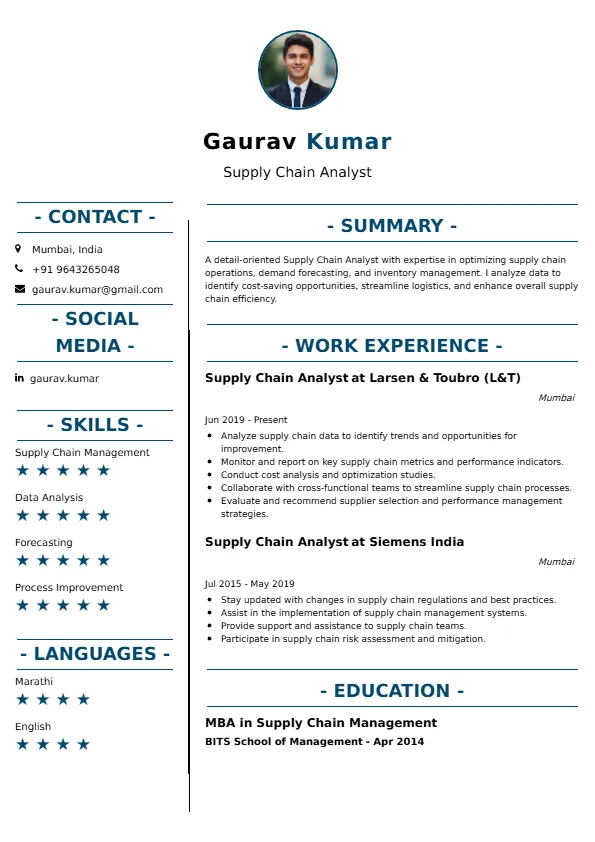
Supply Chain Analyst
Welcome to our Supply Chain Analyst resume sample page! This expertly crafted resume template is designed to showcase your expertise in collecting, analyzing, and reporting supply chain data, developing predictive models (demand/inventory), optimizing logistics networks, and identifying cost savings and process improvements. Whether you focus on planning, logistics, or procurement, this sample highlights key skills like Data Analysis (SQL/Python), Demand/Inventory Planning, Network Modeling, Transportation Management Systems (TMS), and Process Optimization (Lean) tailored to meet top corporate and manufacturing demands. Use this guide to create a polished, results-driven resume that stands out and secures your next career opportunity.
Superbresume.com empowers Supply Chain Analysts to craft resumes that highlight their data-driven optimization and strategic cost-saving expertise. Our platform offers customizable templates tailored for analytical roles, emphasizing skills like forecasting software (SAP APO/IBP), advanced statistical modeling, inventory policy design, and cross-functional S&OP (Sales & Operations Planning) support. With ATS-optimized formats, expert-written content suggestions, and real-time resume analysis, we ensure your resume aligns with job descriptions. Showcase your experience in significantly reducing working capital, improving forecast accuracy (MAPE), or implementing new network optimization models that achieved major efficiency gains with confidence. Superbresume.com helps you create a polished, results-driven resume that grabs hiring managers’ attention and lands interviews.
How to Write a Resume for a Supply Chain Analyst
Craft a Targeted Summary: Write a 2-3 sentence summary highlighting your expertise in supply chain analysis and optimization, proficiency in data modeling and ERP/SCM systems, and success in reducing costs and improving service levels through data-driven recommendations.
Use Reverse-Chronological Format: List recent supply chain, logistics, or industrial engineering analyst roles first, focusing on measurable optimization and efficiency achievements.
Highlight Certifications/Training: Include credentials like APICS Certified in Planning and Inventory Management (CPIM), Certified Supply Chain Professional (CSCP), Lean Six Sigma, or specialized forecasting software certifications to boost credibility.
Quantify Achievements: Use metrics, e.g., “Improved customer fill rate from 95% to 98% by optimizing inventory deployment models, reducing stockouts by 30%,” or “Reduced annual logistics costs by 12% ($1M) through detailed route optimization and carrier rate analysis using Python,” to show impact.
Incorporate Keywords: Use terms like “Demand Forecasting & Planning,” “Inventory Optimization (Safety Stock/ROP),” “Supply Chain Modeling (Network),” “Data Analysis (SQL/Python/R),” “ERP/SCM Systems (SAP/Oracle),” “Process Optimization (Lean/Six Sigma),” or “Sales & Operations Planning (S&OP)” from job descriptions for ATS.
Detail Technical Skills: List proficiency with specific software (SAP APO, Kinaxis, TMS/WMS, Tableau/Power BI), statistical analysis (time series, regression), operations research, and advanced Excel/SQL in a dedicated skills section.
Showcase Analytical Projects: Highlight 3-4 key projects (e.g., warehouse network consolidation study, new inventory policy implementation, demand model validation), detailing the methodology, the challenge, and the quantified financial/efficiency result.
Emphasize Soft Skills: Include analytical rigor, strategic thinking, attention to detail, cross-functional collaboration (with Sales, Operations), and problem-solving (disruption/bottlenecks).
Keep It Concise: Limit your resume to 1-2 pages, focusing on relevant supply chain analysis, modeling, and planning experience.
Proofread Thoroughly: Eliminate typos or jargon for a professional document.
Predictive Modeling and Machine Learning: Focus on expertise utilizing statistical software (Python/R) and ML techniques to build and validate advanced demand and inventory forecasting models, improving accuracy beyond traditional methods.
Network Design and Simulation: Highlight skills in utilizing specialized software (e.g., Llamasoft) or custom models to simulate and optimize the physical location, flow, and capacity of the supply chain network (warehouses, factories, distribution).
S&OP (Sales & Operations Planning) Support: Showcase experience preparing key data inputs, analyzing demand/supply variability, and facilitating consensus during the monthly S&OP process to align business functions.
Data Visualization and Reporting: Detail advanced proficiency using BI tools (Tableau/Power BI) to create interactive dashboards for real-time monitoring of supply chain KPIs (e.g., inventory turns, forecast accuracy, OTD).
End-to-End Visibility and Data Integration: Emphasize expertise writing complex SQL queries to extract data from disparate ERP/TMS/WMS systems and ensuring data integrity across the supply chain.
Metrics-Driven Achievements: Use results like “Reduced inventory working capital by 15% by refining the safety stock methodology across 500+ SKUs” or “Improved forecast accuracy (MAPE) by 10 points, leading to a 5% reduction in expedited shipping costs.”
Supplier Risk and Resilience Modeling: Include experience modeling lead time variability, supplier concentration risk, and developing scenario analysis to enhance the supply chain's resilience against disruptions.
Process Automation and Efficiency: Highlight experience identifying and documenting manual supply chain processes (e.g., order expediting, data transfer) suitable for automation (RPA, Python scripting) to improve analyst efficiency.
Choose Superbresume.com to craft a Supply Chain Analyst resume that stands out in the essential operations and logistics sector. Our platform offers tailored templates optimized for ATS, ensuring your skills in data modeling, inventory optimization, and S&OP support shine. With expert guidance, pre-written content, and real-time feedback, we help you highlight achievements like reducing working capital or improving forecast accuracy. Whether you focus on planning or logistics, our tools make it easy to create a polished, results-driven resume. Trust Superbresume.com to showcase your expertise in data-driven supply chain strategy and operational efficiency. Start building your career today!
20 Key Skills for a Supply Chain Analyst Resume
| Demand Forecasting & Planning (Statistical Modeling) | Inventory Optimization Models (Safety Stock, ROP) |
| Data Analysis (SQL, Python/R, Advanced Excel) | Supply Chain Modeling & Network Design |
| ERP/SCM System Proficiency (SAP APO/Oracle SCM) | Process Optimization (Lean/Six Sigma) |
10 Do’s for a Supply Chain Analyst Resume
Tailor Your Resume: Customize for the specific function (e.g., emphasize demand planning, emphasize logistics network analysis) and the industry.
Highlight Certifications/Training: List APICS CPIM/CSCP and relevant software/analytics training prominently.
Quantify Achievements: Include metrics on working capital reduction, forecast accuracy improvement (MAPE), service level achievement (fill rate), or cost savings identified.
Use Action Verbs: Start bullet points with verbs like “analyzed,” “optimized,” “modeled,” “forecasted,” or “implemented.”
Showcase Analytical Projects: Detail the methodology and the strategic, quantified financial/efficiency result of 3-4 key optimization projects.
Include Soft Skills: Highlight analytical rigor, strategic thinking, attention to detail, and cross-functional collaboration.
Optimize for ATS: Use standard supply chain/analytics section titles and incorporate key planning, ERP, and metric terms.
Keep It Professional: Use a clean, consistent font and professional layout.
Emphasize Optimization and Data: Clearly articulate expertise in using data and quantitative models to drive supply chain decision-making.
Proofread Thoroughly: Eliminate typos or jargon for a professional document.
10 Don’ts for a Supply Chain Analyst Resume
Don’t Overload with Jargon: Avoid confusing, internal company acronyms; use standardized supply chain and planning terminology.
Don’t Exceed Two Pages: Keep your resume concise, focusing on high-impact supply chain analysis and optimization achievements.
Don’t Omit Dates: Include employment dates for career context.
Don’t Use Generic Templates: Tailor your resume specifically to the analytical, quantitative duties of a Supply Chain Analyst.
Don’t List Irrelevant Skills: Focus on planning models, forecasting, ERP systems, statistical analysis, and logistics.
Don’t Skip Metrics: Quantify results wherever possible; working capital, forecast accuracy, and cost savings are key metrics.
Don’t Use Complex Formats: Avoid highly stylized elements or confusing graphics.
Don’t Ignore System Proficiency: Include mastery of specific ERP/SCM or BI software.
Don’t Include Outdated Experience: Omit non-analytical or irrelevant jobs over 15 years old.
Don’t Forget to Update: Refresh for new APICS certification, successful network redesign models, or advanced forecasting software training.
5 FAQ's for a Supply Chain Analyst Resume
Prioritize SQL, Advanced Excel (Power Query/VBA), and BI tools like Tableau or Power BI. Mentioning ERPs like SAP or Oracle is also vital..
Use specific metrics: "Reduced transportation costs by 12% by redesigning distribution routes using network modeling software."
Yes. Focus on "reducing carrying costs" or "improving inventory turnover rates (ITR)" through data-driven forecasting.
Very. Describe how you "modeled 'what-if' scenarios for global port disruptions to mitigate supply chain risk."
"Analyzed supplier performance data to identify bottlenecks, resulting in a 15% reduction in raw material lead times."
Get 5x more interviews with our crafted Resumes. We make resumes that land jobs.

Get a Free Customized Cover Letter with Resume Expert Advice
with every resume order placed, you will get a free Customized Cover letter.