Safety Officer
Welcome to our Safety Officer resume sample page! This expertly crafted resume template is designed to showcase your expertise in developing, implementing, and enforcing safety, health, and environmental (HSE) policies, conducting site inspections/audits, leading training, and ensuring compliance with regulatory bodies (OSHA, EPA) in construction, manufacturing, or industrial settings. Whether you focus on site safety or regulatory management, this sample highlights key skills like OSHA Compliance, Safety Auditing, Incident Investigation, Training & Education, and Risk Assessment/Mitigation tailored to meet top industrial demands. Use this guide to create a polished, results-driven resume that stands out and secures your next career opportunity.
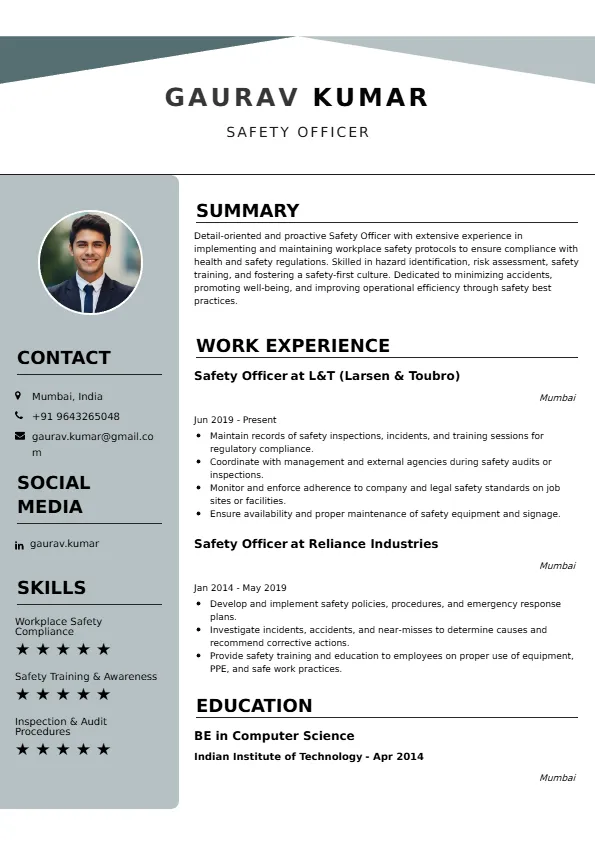
Superbresume.com empowers Safety Officers to craft resumes that highlight their regulatory compliance and incident prevention expertise. Our platform offers customizable templates tailored for HSE roles, emphasizing skills like Job Safety Analysis (JSA), hazard communication (HazCom), LOTO procedure enforcement, and Total Recordable Incident Rate (TRIR) reduction strategies. With ATS-optimized formats, expert-written content suggestions, and real-time resume analysis, we ensure your resume aligns with job descriptions. Showcase your experience in successfully achieving zero Lost Time Incidents (LTI), leading comprehensive site safety audits, or implementing new training programs that reduced worker injury rates with confidence. Superbresume.com helps you create a polished, results-driven resume that grabs hiring managers’ attention and lands interviews.
How to Write a Resume for a Safety Officer
Craft a Targeted Summary: Write a 2-3 sentence summary highlighting your certification, extensive experience in industrial/construction safety management, proficiency in OSHA/EPA compliance and risk assessment, and success in achieving zero Lost Time Incidents (LTI) and reducing overall injury rates.
Use Reverse-Chronological Format: List recent safety officer, EHS specialist, or industrial hygiene roles first, focusing on measurable safety and compliance achievements.
Highlight Certifications/Training: Include credentials like Certified Safety Professional (CSP), OSHA 30/500 Certification, relevant industry-specific certifications (e.g., First Aid Instructor), or technical degrees (OHS/Engineering) to boost credibility.
Quantify Achievements: Use metrics, e.g., “Led safety operations for 100+ construction workers, achieving 500+ consecutive days without a Lost Time Incident (LTI),” or “Reduced the Total Recordable Incident Rate (TRIR) by 25% year-over-year through targeted training and inspection programs,” to show impact.
Incorporate Keywords: Use terms like “OSHA Compliance & Reporting (300 Log),” “Safety Auditing & Inspection,” “Incident Investigation & Root Cause Analysis (RCA),” “Job Safety Analysis (JSA),” “LOTO (Lockout/Tagout) Enforcement,” “Hazard Communication (HazCom),” or “Risk Assessment/Mitigation” from job descriptions for ATS.
Detail Technical/Safety Skills: List proficiency with specific safety standards (OSHA 1910/1926), training methodologies, emergency response protocols, specialized equipment (e.g., confined space, fall protection), and incident reporting software in a dedicated skills section.
Showcase Safety Projects: Highlight 3-4 key initiatives (e.g., implementing a new LOTO procedure, leading a site-wide safety audit, developing a near-miss reporting program), detailing the methodology, the challenge, and the quantified safety/compliance result.
Emphasize Soft Skills: Include decisive leadership, systematic problem-solving, attention to detail (protocol), strong communication (training/reporting), and ability to enforce compliance fairly.
Keep It Concise: Limit your resume to 1-2 pages, focusing on relevant safety, compliance, and risk mitigation experience.
Proofread Thoroughly: Eliminate typos or jargon for a professional document.
Proactive Risk Assessment and JSA: Focus on advanced skills in conducting Job Safety Analysis (JSA), leading hazard identification, and implementing proactive controls to prevent incidents, moving beyond reactive response.
Safety Data Analytics and TRIR Reduction: Highlight expertise utilizing data (e.g., incident reports, near-misses) and statistical analysis to identify high-risk areas, measure the effectiveness of interventions, and drive down TRIR.
Behavior-Based Safety (BBS) Programs: Showcase experience implementing and managing BBS programs, utilizing observation and feedback to positively influence employee safety behavior and culture.
Environmental Health and Safety (EHS) Integration: Detail knowledge and experience managing both worker safety (OSHA) and environmental compliance (EPA, waste disposal, air quality), particularly in industrial settings.
Digital Safety Systems and Reporting: Emphasize proficiency utilizing mobile applications and specialized software (e.g., EHS Insight, Gensuite) for field inspections, incident reporting, and compliance documentation.
Metrics-Driven Achievements: Use results like “Reduced property damage incidents by 15% by improving equipment inspection checklists” or “Successfully managed the site through 2 external OSHA inspections with zero citations.”
LOTO and Energy Control Expertise: Include advanced proficiency managing complex LOTO procedures, auditing energy control policies, and ensuring full compliance with equipment isolation requirements.
Crisis and Emergency Response Leadership: Highlight experience leading safety response teams, managing emergency drills, and serving as the primary incident commander for on-site emergencies.
Choose Superbresume.com to craft a Safety Officer resume that stands out in the critical industrial and construction safety sector. Our platform offers tailored templates optimized for ATS, ensuring your skills in OSHA compliance, risk assessment, and incident prevention shine. With expert guidance, pre-written content, and real-time feedback, we help you highlight achievements like achieving zero LTIs or significantly reducing injury rates. Whether you focus on construction or manufacturing, our tools make it easy to create a polished, results-driven resume. Trust Superbresume.com to showcase your expertise in reliable, proactive, and compliant safety leadership. Start building your career today!
20 Key Skills for a Safety Officer Resume
| OSHA Compliance & Reporting (300 Log) | Safety Auditing & Site Inspection |
| Incident Investigation & Root Cause Analysis (RCA) | Lockout/Tagout (LOTO) Procedures & Enforcement |
| Job Safety Analysis (JSA) & Risk Assessment | Safety Training & Education Delivery |
| Fall Protection & Confined Space Protocols | Behavior-Based Safety (BBS) Implementation |
10 Do’s for a Safety Officer Resume
Tailor Your Resume: Customize for the specific industry (e.g., emphasize construction standards 1926, emphasize industrial hygiene 1910).
Highlight Certifications/Training: List CSP, OSHA 30/500, and specialized safety certifications prominently.
Quantify Achievements: Include metrics on TRIR/DART rate reduction, LTI-free days, successful audit results, or training volume/impact.
Use Action Verbs: Start bullet points with verbs like “enforced,” “investigated,” “trained,” “reduced,” or “led.”
Showcase Safety Initiatives: Detail the methodology and the strategic, quantified injury/compliance result of 3-4 key safety projects.
Include Soft Skills: Highlight decisive leadership, systematic problem-solving, attention to detail, and strong communication (training/enforcement).
Optimize for ATS: Use standard safety/EHS section titles and incorporate key OSHA, compliance, and methodology terms.
Keep It Professional: Use a clean, consistent font and professional layout.
Emphasize Prevention and Compliance: Clearly articulate expertise in proactive risk mitigation (JSA) and strict adherence to OSHA standards.
Proofread Thoroughly: Eliminate typos or jargon for a professional document.
10 Don’ts for a Safety Officer Resume
Don’t Overload with Jargon: Avoid confusing, internal company or site acronyms; use standardized OSHA and safety terminology.
Don’t Exceed Two Pages: Keep your resume concise, focusing on high-impact safety, compliance, and risk mitigation achievements.
Don’t Omit Dates: Include employment dates for career context.
Don’t Use Generic Templates: Tailor your resume specifically to the specialized, high-stakes duties of a Safety Officer.
Don’t List Irrelevant Skills: Focus on safety standards, inspection, investigation, training, and risk assessment.
Don’t Skip Metrics: Quantify results wherever possible; TRIR, LTI, and audit success are key metrics.
Don’t Use Complex Formats: Avoid highly stylized elements or confusing graphics.
Don’t Ignore Training/Culture: Include explicit experience leading training and driving cultural change (BBS).
Don’t Include Outdated Experience: Omit non-safety or non-technical jobs over 15 years old.
Don’t Forget to Update: Refresh for new CSP certification, successful incident reduction projects, or advanced training.
5 FAQ's for a Safety Officer Resume
List OSHA 30, CSP (Certified Safety Professional), or NEBOSH.
"Reduced Total Recordable Incident Rate (TRIR) by 40% through the implementation of a Near-Miss reporting system."
Yes. "Conducted 100+ site safety audits annually, ensuring 100% compliance with EPA and DOT regulations."
"Delivered safety orientations to 1,000+ employees, resulting in a 20% improvement in safety knowledge assessment scores."
Yes. Mention your role in "claims investigation and return-to-work coordination."
Get 5x more interviews with our crafted Resumes. We make resumes that land jobs.

Get a Free Customized Cover Letter with Resume Expert Advice
with every resume order placed, you will get a free Customized Cover letter.