Research Assistant
Welcome to our Research Assistant resume sample page! This expertly crafted resume template is designed to showcase your expertise in supporting academic or clinical research studies, executing experiments, collecting and managing data, maintaining lab/field compliance, and assisting with report/manuscript preparation. Whether you work in a university lab, clinical trial setting, or government agency, this sample highlights key skills like Experimental Execution, Data Collection/Entry, Laboratory/Fieldwork Techniques, Documentation Compliance (IRB/HIPAA), and Literature Review tailored to meet top scientific and academic demands. Use this guide to create a polished, results-driven resume that stands out and secures your next career opportunity.
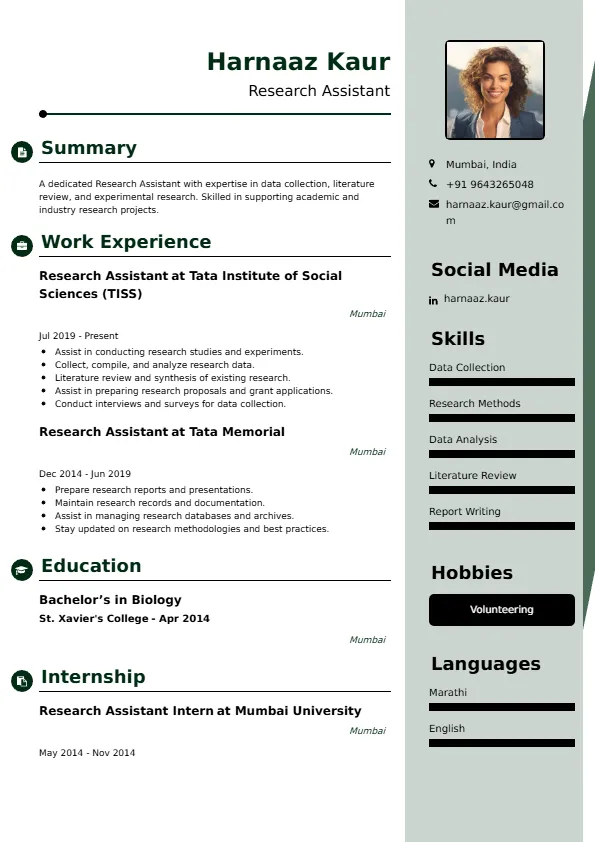
Superbresume.com empowers Research Assistants to craft resumes that highlight their technical competence and meticulous methodological support. Our platform offers customizable templates tailored for research roles, emphasizing skills like SOP adherence, statistical software proficiency (basic), sterile/aseptic technique, and regulatory documentation (IRB/GCP). With ATS-optimized formats, expert-written content suggestions, and real-time resume analysis, we ensure your resume aligns with job descriptions. Showcase your experience in successfully executing complex protocols, maintaining high data accuracy, or assisting with research that resulted in publication/presentation with confidence. Superbresume.com helps you create a polished, results-driven resume that grabs hiring managers’ attention and lands interviews.
How to Write a Resume for a Research Assistant
Craft a Targeted Summary: Write a 2-3 sentence summary highlighting your expertise in supporting scientific/clinical research, proficiency in experimental execution and data management, and commitment to methodological rigor, accuracy, and regulatory compliance.
Use Reverse-Chronological Format: List recent research assistant, lab technician, or relevant academic roles first, focusing on measurable technical and project support achievements.
Highlight Certifications/Training: Include credentials like Good Clinical Practice (GCP) certification, laboratory safety training (OSHA), specialized technical training (e.g., PCR), or relevant science/research degrees to boost credibility.
Quantify Achievements: Use metrics, e.g., “Executed 50+ complex biochemical assays with a 99% accuracy rate, minimizing sample contamination,” or “Managed the data collection and entry for a 200-patient clinical trial, ensuring 100% IRB protocol adherence,” to show impact.
Incorporate Keywords: Use terms like “Experimental Execution,” “Data Collection & Management,” “IRB/GCP Compliance,” “Laboratory/Fieldwork Techniques (Specify),” “SOP Adherence,” “Statistical Software Familiarity (SPSS/R),” or “Literature Review & Synthesis” from job descriptions for ATS.
Detail Technical/Lab Skills: List proficiency with specific lab equipment (e.g., centrifuges, microscopes), data collection software (Qualtrics, REDCap), statistical tools (basic), technical procedures (PCR, western blot), and safety protocols in a dedicated skills section.
Showcase Research Projects: Highlight 3-4 key studies or projects supported, detailing the methodology, the specific tasks performed (e.g., data analysis, subject recruitment), and the project's output (presentation, manuscript submission).
Emphasize Soft Skills: Include meticulous attention to detail, adherence to protocol, analytical observation, organization, and strong communication (PI/team).
Keep It Concise: Limit your resume to 1 page, focusing on relevant research support, technical, and compliance experience.
Proofread Thoroughly: Eliminate typos or jargon for a professional document.
Data Management and Analysis Tools: Focus on expertise collecting and cleaning data using advanced tools (REDCap, Qualtrics) and preparing datasets for statistical analysis using R, Python (Pandas), or SPSS.
Protocol Adherence and Regulatory Compliance: Highlight meticulous attention to following the detailed study protocol (IRB/GCP), maintaining accurate source documentation, and managing informed consent procedures.
Advanced Laboratory Techniques: Showcase proficiency in specific, high-demand technical procedures relevant to the field (e.g., molecular biology techniques, flow cytometry, specialized imaging).
Subject Recruitment and Retention: Detail successful strategies and experience recruiting and retaining study participants, managing scheduling, and ensuring compensation/follow-up compliance.
Literature Review and Writing Support: Emphasize skills conducting comprehensive literature reviews, synthesizing academic papers, and assisting the Principal Investigator (PI) with drafting manuscripts, reports, or grant sections.
Metrics-Driven Achievements: Use results like “Achieved a 90% patient recruitment goal for a Phase II clinical trial on time” or “Successfully managed the inventory and ordering for a lab, reducing stock-outs by 95%.”
Aseptic Technique and Safety: Include strict adherence to sterile procedures, chemical handling, and lab safety protocols (e.g., biosafety level compliance).
Remote Data Collection: Highlight experience utilizing digital platforms and telehealth tools for remote data collection (e.g., surveys, interviews) from participants.20 Key Skills for a Research Assistant
| Experimental Execution & SOP Adherence | Data Collection, Entry, & Management (REDCap/Qualtrics) |
| IRB/GCP Compliance & Regulatory Documentation | Laboratory Techniques (e.g., PCR, Western Blot, Microscopy) |
| Statistical Software Familiarity (SPSS/R) | Literature Review & Synthesis |
10 Do’s for a Research Assistant
Tailor Your Resume: Customize for the specific research discipline (e.g., molecular biology, clinical psychology, public health) and the required techniques.
Highlight Certifications/Training: List GCP, CITI, or specialized lab safety certifications prominently.
Quantify Achievements: Include metrics on sample volume processed, data accuracy rates, recruitment goals met, or efficiency gains in lab processes.
Use Action Verbs: Start bullet points with verbs like “executed,” “collected,” “managed,” “analyzed,” or “assisted.”
Showcase Protocol Adherence: Detail the methodology and the strategic, quantified accuracy/efficiency result of 3-4 key research tasks.
Include Soft Skills: Highlight meticulous detail, adherence to protocol, analytical observation, and strong organizational skills.
Optimize for ATS: Use standard research section titles and incorporate key technical and compliance terms.
Keep It Concise: Limit your resume to one page, focusing on relevant research support and technical experience.
Emphasize Data and Compliance: Clearly articulate expertise in collecting accurate data and maintaining strict regulatory compliance (IRB/GCP).
Proofread Thoroughly: Eliminate typos or jargon for a professional document.
10 Don’ts for a Research Assistant
Don’t Overload with Jargon: Avoid confusing, internal lab or project acronyms; use standardized scientific and regulatory terminology.
Don’t Exceed One Page: Keep your resume sharp and focused on the most relevant, measurable duties.
Don’t Omit Dates: Include employment dates for career context.
Don’t Use Generic Templates: Tailor your resume specifically to the detailed, protocol-driven duties of a Research Assistant.
Don’t List Irrelevant Skills: Focus on experimental technique, data collection, regulatory compliance, and literature review.
Don’t Skip Metrics: Quantify results wherever possible; link achievements to accuracy, volume, or recruitment rates.
Don’t Use Complex Formats: Avoid highly stylized elements or confusing graphics.
Don’t Ignore Documentation: Include explicit experience managing source documentation and lab notebooks.
Don’t Include Outdated Experience: Omit non-research or non-technical jobs over 10 years old.
Don’t Forget to Update: Refresh for new certification mastery, successful protocol execution, or advanced data management software proficiency.
5 FAQ's for a Research Assistant
))0ombx/19"Maintained 100% accuracy in data logging for a longitudinal study involving 500+ participants."
Yes. Mention PCR, Gel Electrophoresis, Titration, or Survey Administration depending on your field.
"Synthesized 50+ academic papers to provide foundational data for a grant proposal that secured $100K in funding."
Mention IRB (Institutional Review Board) protocols, HIPAA, or GLP (Good Laboratory Practice).
Yes. List them under "Publications/Presentations" and specify your role (e.g., "Assisted in data collection and formatting").
Get 5x more interviews with our crafted Resumes. We make resumes that land jobs.

Get a Free Customized Cover Letter with Resume Expert Advice
with every resume order placed, you will get a free Customized Cover letter.