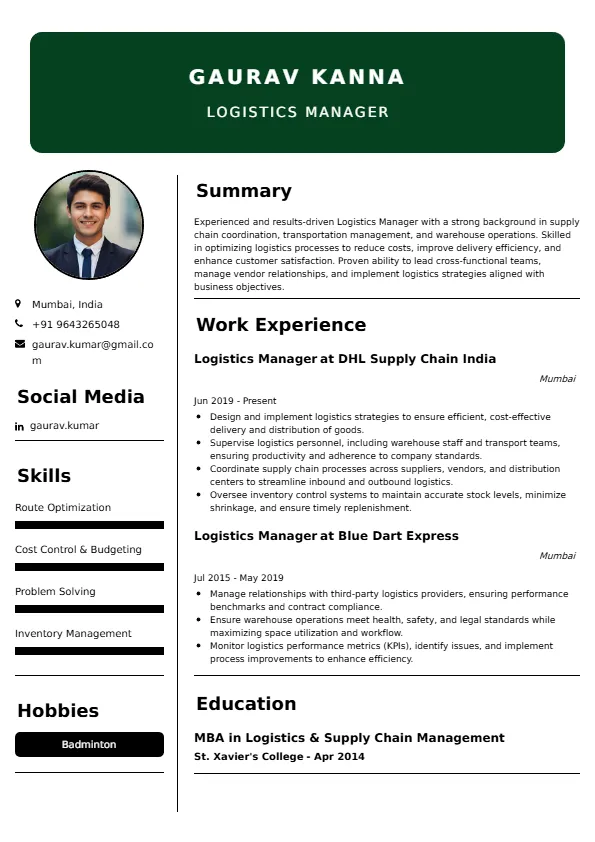
Logistics Manager
Welcome to our Logistics Manager resume sample page! This expertly crafted resume template is designed to showcase your expertise in leading logistics operations, managing teams, overseeing budgets, developing carrier strategies, and ensuring efficient and compliant movement of goods across the supply chain. Whether you manage transportation, warehousing, or distribution, this sample highlights key skills like P&L Management, TMS/WMS Strategy, Team Leadership, Regulatory Compliance (DOT/Customs), and Process Optimization (Lean/Six Sigma) tailored to meet top manufacturing, retail, and 3PL demands. Use this guide to create a compelling resume that stands out and secures your next career opportunity.
Superbresume.com empowers Logistics Managers to craft resumes that highlight their strategic operational command and financial accountability. Our platform offers customizable templates tailored for management roles, emphasizing skills like network optimization, contract negotiation (Carrier/3PL), global trade compliance, and implementing logistics technology (TMS/WMS). With ATS-optimized formats, expert-written content suggestions, and real-time resume analysis, we ensure your resume aligns with job descriptions. Showcase your experience in significantly reducing transportation budgets, leading successful warehouse/distribution center operations, or achieving major improvements in customer service levels (OTD/OTIF) with confidence. Superbresume.com helps you create a polished, results-driven resume that grabs hiring managers’ attention and lands interviews.
How to Write a Resume for a Logistics Manager
Craft a Targeted Summary: Write a 2-3 sentence summary highlighting your leadership in full-scope logistics management, success in managing P&L/budgets and optimizing networks, and expertise in team leadership, regulatory compliance, and driving measurable efficiency gains.
Use Reverse-Chronological Format: List recent Logistics Manager, Director of Distribution, or Supply Chain leadership roles first, focusing on measurable operational, financial, and team achievements.
Highlight Certifications/Training: Include credentials like APICS Certified Supply Chain Professional (CSCP), Certified Transportation Professional (CTP), Lean Six Sigma, or relevant MBA/Master’s Degree to boost credibility.
Quantify Achievements: Use metrics, e.g., “Managed a $25M annual transportation budget, reducing total freight spend by 10% through carrier contract negotiation,” or “Improved on-time delivery (OTD) rate from 94% to 98.5% across a national network, directly increasing customer satisfaction,” to show impact.
Incorporate Keywords: Use terms like “Transportation Management System (TMS) Strategy,” “P&L Management (Logistics Budget),” “Carrier Contract Negotiation,” “Regulatory Compliance (DOT/Customs),” “Team Leadership & Mentoring,” “Process Optimization (Lean),” or “On-Time Delivery (OTD/OTIF)” from job descriptions for ATS.
Detail Leadership/Technical Skills: List expertise in budget forecasting, staff supervision, vendor contract management, TMS/WMS strategy, regulatory compliance (DOT/HOS, Incoterms), and data-driven decision-making in a dedicated skills section.
Showcase Strategic Projects: Highlight 3-4 key initiatives (e.g., implementing a new TMS, optimizing a warehouse layout, leading a major carrier RFP), detailing the scope, the challenge, and the quantified financial/efficiency result.
Emphasize Soft Skills: Include strategic thinking, decisive leadership, negotiation, change management (for system/process rollouts), and strong communication (to executives/staff).
Keep It Concise: Limit your resume to 1-2 pages, focusing on relevant logistics leadership, strategy, and measurable financial/operational experience.
Proofread Thoroughly: Eliminate typos or jargon for a professional document.
Logistics Technology Strategy (TMS/WMS/Telematics): Focus on leading the selection, implementation, and optimization of the core logistics technology stack, ensuring seamless data flow and process automation.
Carrier and 3PL Contract Negotiation: Highlight expertise leading high-stakes negotiations with freight carriers and third-party logistics (3PL) providers to secure favorable rates, service levels, and capacity.
Omni-Channel and E-commerce Fulfillment: Showcase strategic leadership in designing logistics networks and processes that efficiently support both traditional retail and high-volume e-commerce/last-mile fulfillment.
Global Trade and Compliance Oversight: Detail experience managing international shipping complexity, ensuring adherence to customs regulations, Incoterms, and managing export/import risk.
Process Optimization and Continuous Improvement: Emphasize utilizing Lean/Six Sigma methodology (VSM, Kaizen) to identify and eliminate waste in transportation, warehousing, and inventory movement.
Metrics-Driven Achievements: Use results like “Reduced logistics operating costs by 15% through a Lean process re-engineering project” or “Improved dock-to-stock time in the DC by 20%.”
Risk Management and Resilience: Include experience developing logistics contingency plans for disruptions (e.g., port congestion, labor issues) and ensuring business continuity.
Team Development and Mentoring: Highlight experience recruiting, mentoring, and advancing the skills of logistics coordinators, analysts, and warehouse supervisors.
Choose Superbresume.com to craft a Logistics Manager resume that stands out in the essential supply chain leadership sector. Our platform offers tailored templates optimized for ATS, ensuring your skills in P&L management, TMS strategy, and process optimization shine. With expert guidance, pre-written content, and real-time feedback, we help you highlight achievements like achieving massive cost savings or boosting on-time delivery performance. Whether you manage a national fleet or a global distribution network, our tools make it easy to create a polished, results-driven resume. Trust Superbresume.com to showcase your expertise in strategic, efficient, and compliant logistics command. Start building your career today!
20 Key Skills for a Logistics Manager Resume
| Logistics P&L Management & Budgeting | Transportation Management System (TMS) Strategy |
| Carrier/3PL Contract Negotiation | Team Leadership & Staff Supervision |
| Process Optimization (Lean/Six Sigma) | On-Time Delivery (OTD/OTIF) Metrics |
| Regulatory Compliance (DOT, Customs, HOS) | Warehouse/Distribution Center Operations |
| Network Design & Optimization | Global Trade & Incoterms Knowledge |
| Freight Cost Reduction & Auditing | Supply Chain Planning (S&OP Interface) |
| Logistics Risk Management & Resilience | WMS/ERP System Strategy |
10 Do’s for a Logistics Manager Resume
Tailor Your Resume: Customize for the specific mode (e.g., focus on Truckload/Rail, focus on Ocean/Air) and the scope of management (e.g., departmental, multi-site).
Highlight Certifications/Training: List APICS CSCP, CTP, or Lean Six Sigma certifications prominently.
Quantify Achievements: Include metrics on budget size managed (dollar amount), cost reduction (percentage/dollar), OTD/OTIF improvement, or team size supervised.
Use Action Verbs: Start bullet points with verbs like “led,” “managed,” “optimized,” “negotiated,” or “strategized.”
Showcase Strategic Projects: Detail the methodology and the strategic, quantified financial/efficiency result of 3-4 key logistics initiatives.
Include Soft Skills: Highlight strategic thinking, decisive leadership, financial acumen, and strong negotiation/communication.
Optimize for ATS: Use standard management section titles and incorporate key financial, regulatory, and system terms.
Keep It Professional: Use a clean, consistent font and professional layout.
Emphasize P&L and Strategy: Clearly articulate experience managing technology, people, and budget to drive strategic logistics results.
Proofread Thoroughly: Eliminate typos or jargon for a professional document.
10 Don’ts for a Logistics Manager Resume
Don’t Overload with Jargon: Avoid confusing, internal company acronyms; use standardized logistics, supply chain, and regulatory terminology.
Don’t Exceed Two Pages: Keep your resume concise, focusing on high-level logistics leadership, strategy, and operational achievements.
Don’t Omit Dates: Include employment dates for career context.
Don’t Use Generic Templates: Tailor your resume specifically to the strategic, budget-owning duties of a Logistics Manager.
Don’t List Irrelevant Skills: Focus on management, budget, strategy, compliance, and logistics systems.
Don’t Skip Metrics: Quantify results wherever possible; cost savings, service level, and budget adherence are key metrics.
Don’t Use Complex Formats: Avoid highly stylized elements or confusing graphics.
Don’t Ignore Compliance/Safety: Include explicit experience ensuring DOT, HOS, or Customs compliance.
Don’t Include Outdated Experience: Omit low-level operational or non-management jobs over 15 years old.
Don’t Forget to Update: Refresh for new CSCP status, successful carrier contract negotiations, or advanced logistics technology strategy development.
5 FAQ's for a Logistics Manager Resume
"Managed a $25M annual logistics budget, achieving a 10% YOY cost reduction through network redesign."
Yes. "Oversaw the RFP process and performance of 3 external 3PL providers."
"Achieved a 0% OSHA-recordable incident rate across the distribution center for 2 consecutive years."
Yes. Mention managing the "returns and recycling flow to recover asset value."
"Led a team of 10 coordinators and 50 warehouse staff to achieve 98% On-Time-In-Full (OTIF) rates."
Get 5x more interviews with our crafted Resumes. We make resumes that land jobs.

Get a Free Customized Cover Letter with Resume Expert Advice
with every resume order placed, you will get a free Customized Cover letter.