Grant Writer
Welcome to our Grant Writer resume sample page! This expertly crafted resume template is designed to showcase your expertise in researching funding opportunities, developing persuasive proposals, writing compelling narratives, and ensuring strict compliance with funder guidelines for non-profit, educational, or research organizations. Whether you're an entry-level candidate or a seasoned professional, this sample highlights key skills like proposal development, budget creation, funder relationship management, research, and technical writing tailored to meet top organizational demands. Use this guide to create a compelling resume that stands out and secures your next career opportunity.
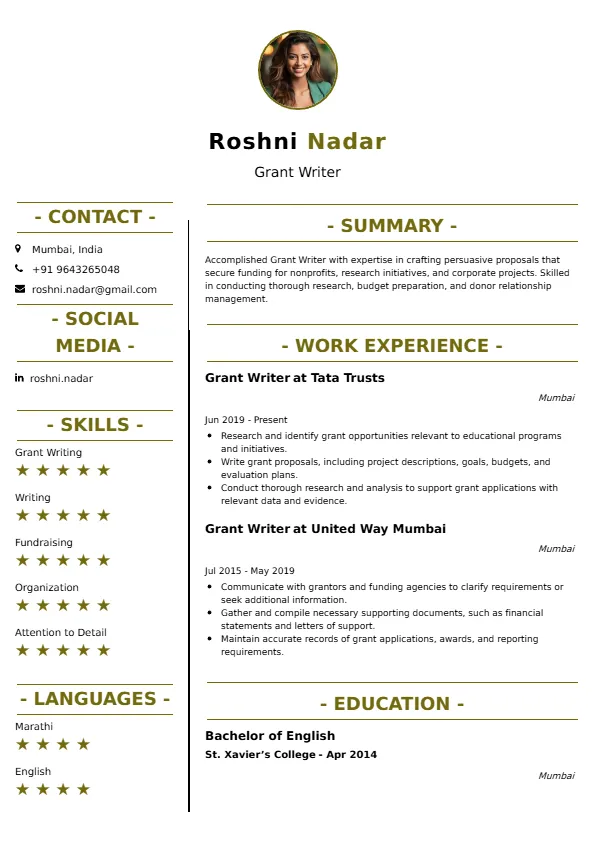
Superbresume.com empowers Grant Writers to craft resumes that highlight their proposal success rate and persuasive communication expertise. Our platform offers customizable templates tailored for development roles, emphasizing skills like prospect research tools (Foundation Directory), detailed budget narrative drafting, program evaluation synthesis, and federal grant application proficiency (Grants.gov). With ATS-optimized formats, expert-written content suggestions, and real-time resume analysis, we ensure your resume aligns with job descriptions. Showcase your experience in successfully securing five- and six-figure grants, managing complex proposal teams, or maintaining flawless compliance with reporting requirements with confidence. Superbresume.com helps you create a polished, results-driven resume that grabs hiring managers’ attention and lands interviews.
How to Write a Resume for a Grant Writer
Craft a Targeted Summary: Write a 2-3 sentence summary highlighting your expertise in securing grant funding, track record of successful proposal development (quantified), and proficiency in research, persuasive writing, and managing compliance and reporting.
Use Reverse-Chronological Format: List recent grant writing, development, or technical writing roles first, focusing on measurable funding acquisition and submission achievements.
Highlight Certifications/Training: Include credentials like Certified Grant Professional (CGP), specialized training in federal grant compliance, Master’s Degree (Nonprofit Mgmt/MPA), or relevant technical writing certifications to boost credibility.
Quantify Achievements: Use metrics, e.g., “Secured $1.5 million in grant funding over three years from government and foundation sources (80% success rate on federal submissions),” or “Wrote 40+ proposals annually, resulting in a 35% funding success rate,” to show impact.
Incorporate Keywords: Use terms like “Grant Proposal Development,” “Funder Research,” “Budget Narrative,” “Compliance & Reporting (Federal/Foundation),” “Program Evaluation (Logic Model),” “Technical Writing (Proposals),” or “Grants.gov” from job roles for ATS.
Detail Writing/Research Skills: List expertise in proposal structuring, persuasive writing, grant research tools (Foundation Directory), budget justification drafting, and adherence to strict funder guidelines in a dedicated skills section.
Showcase Grant Wins/Submissions: Highlight 3-4 key grants secured or high-value proposals submitted, detailing the funding source, the purpose/program funded, the amount, and the successful outcome (e.g., successful funding, positive review).
Emphasize Soft Skills: Include meticulous attention to detail (compliance), strong written communication, strategic thinking, perseverance (through rejection), and collaboration (with program staff/finance).
Keep It Concise: Limit your resume to 1-2 pages, focusing on relevant grant writing, research, and compliance experience.
Proofread Thoroughly: Eliminate typos or jargon for a professional document.
Program Evaluation Synthesis: Focus on expertise translating complex program evaluation data and Logic Models into compelling narrative sections that prove program impact and justify funding requests.
Federal Grant Compliance and Reporting: Highlight deep knowledge of and experience writing proposals that adhere to stringent federal requirements (e.g., Uniform Guidance 2 CFR 200) and managing subsequent reporting narratives.
Budget Narrative Integration: Showcase skills in creating detailed, justifiable budget narratives that seamlessly link financial figures to programmatic activities and personnel costs.
Digital Submission Platforms: Detail proficiency navigating and mastering complex online grant portals (Grants.gov, NIH eRA Commons, foundation websites) to ensure timely and compliant electronic submission.
Funder Relationship Building: Emphasize involvement in cultivating relationships with program officers through Letters of Inquiry (LOI), site visit preparation, and tailored stewardship reports.
Metrics-Driven Achievements: Use results like “Wrote a proposal that secured a first-time $50K grant from a major foundation” or “Managed an application pipeline with a total ask of $5M annually.”
DEI and Equity Funding: Include experience writing proposals specifically focused on diversity, equity, and inclusion initiatives or targeting funding for underserved populations.
Visual Data Presentation: Highlight skills in integrating data visualization (charts, infographics) within proposals and reports to clearly communicate program need and impact.
Choose Superbresume.com to craft a Grant Writer resume that stands out in the vital non-profit and research funding sector. Our platform offers tailored templates optimized for ATS, ensuring your skills in proposal development, compliance writing, and funding success shine. With expert guidance, pre-written content, and real-time feedback, we help you highlight achievements like securing major grants or maintaining flawless submission compliance. Whether you write for foundations, corporations, or government agencies, our tools make it easy to create a polished, results-driven resume. Trust Superbresume.com to showcase your expertise in translating mission needs into secured funding. Start building your career today!
20 Key Skills for a Grant Writer Resume
| Grant Proposal Development (Full Cycle) | Technical & Persuasive Writing |
| Funder Research & Prospect Identification | Budget Justification & Narrative Drafting |
| Grant Compliance & Reporting (Federal/Foundation) | Program Evaluation Synthesis (Logic Models) |
| Grants.gov/Digital Submission Portals | Cross-Functional Collaboration (Program/Finance) |
| Logic Model & Theory of Change | Funder Relationship Management & LOIs |
| Data Collection & Outcome Reporting | Meticulous Attention to Detail |
| Time Management & Deadline Adherence | Database Management (Donor/Grant Tracking) |
| Federal Uniform Guidance (2 CFR 200) | Proposal Review & Editing |
10 Do’s for a Grant Writer Resume
Tailor Your Resume: Customize for the funding sector (e.g., emphasize science background for NIH grants, emphasize community needs for foundation grants).
Highlight Certifications/Training: List CFRE/CGP certification (or progress) and advanced grant writing training prominently.
Quantify Achievements: Include metrics on total funds secured, proposal success rate (percentage), average grant size, or the number of proposals submitted annually.
Use Action Verbs: Start bullet points with verbs like “wrote,” “secured,” “researched,” “developed,” or “submitted.”
Showcase Grant Wins/Submissions: Detail the methodology and the strategic, quantified funding result of 3-4 key proposals.
Include Soft Skills: Highlight strong written communication, strategic thinking, attention to detail (compliance), and collaboration.
Optimize for ATS: Use standard development/writing section titles and incorporate key grant, compliance, and research terms.
Keep It Professional: Use a clean, consistent font and professional layout.
Emphasize Compliance and Budget: Clearly articulate experience managing the detailed financial/reporting sections of grants.
Proofread Carefully: Ensure no typos or errors in grant names, budgets, or compliance references.
10 Don’ts for a Grant Writer Resume
Don’t Overload with Jargon: Avoid confusing, internal organizational acronyms; use standardized grant writing and regulatory terminology.
Don’t Exceed Two Pages: Keep your resume concise, focusing on high-impact proposal development and funding acquisition achievements.
Don’t Omit Dates: Include employment dates for career context.
Don’t Use Generic Templates: Tailor your resume specifically to the technical writing, research, and compliance duties of a Grant Writer.
Don’t List Irrelevant Skills: Focus on proposal writing, research, budget narrative, compliance, and program evaluation.
Don’t Skip Metrics: Quantify results wherever possible; all achievements must link back to funding secured, success rate, or compliance.
Don’t Use Complex Formats: Avoid highly stylized elements or confusing graphics.
Don’t Ignore Program Impact: Include explicit experience translating program outcomes (Logic Model) into compelling narrative.
Don’t Include Outdated Experience: Omit low-level or non-writing/development jobs over 15 years old.
Don’t Forget to Update: Refresh for new grant awards, successful proposal submissions, or advanced compliance training.
5 FAQ's for a Grant Writer Resume
Yes. This is your strongest selling point (e.g., "Secured $1.5M in cumulative funding over 24 months").
List the types of grants you've written: Federal, State, Private Foundation, and Corporate.
Don't attach it to the resume, but state "Writing samples available upon request" or include a link to a portfolio of non-confidential project summaries.
Mention "partnered with Program Directors and Finance to translate mission goals into justifiable budget narratives."
While English or Communications is common, highlight certifications like the GPC (Grant Professional Certified).
Get 5x more interviews with our crafted Resumes. We make resumes that land jobs.

Get a Free Customized Cover Letter with Resume Expert Advice
with every resume order placed, you will get a free Customized Cover letter.