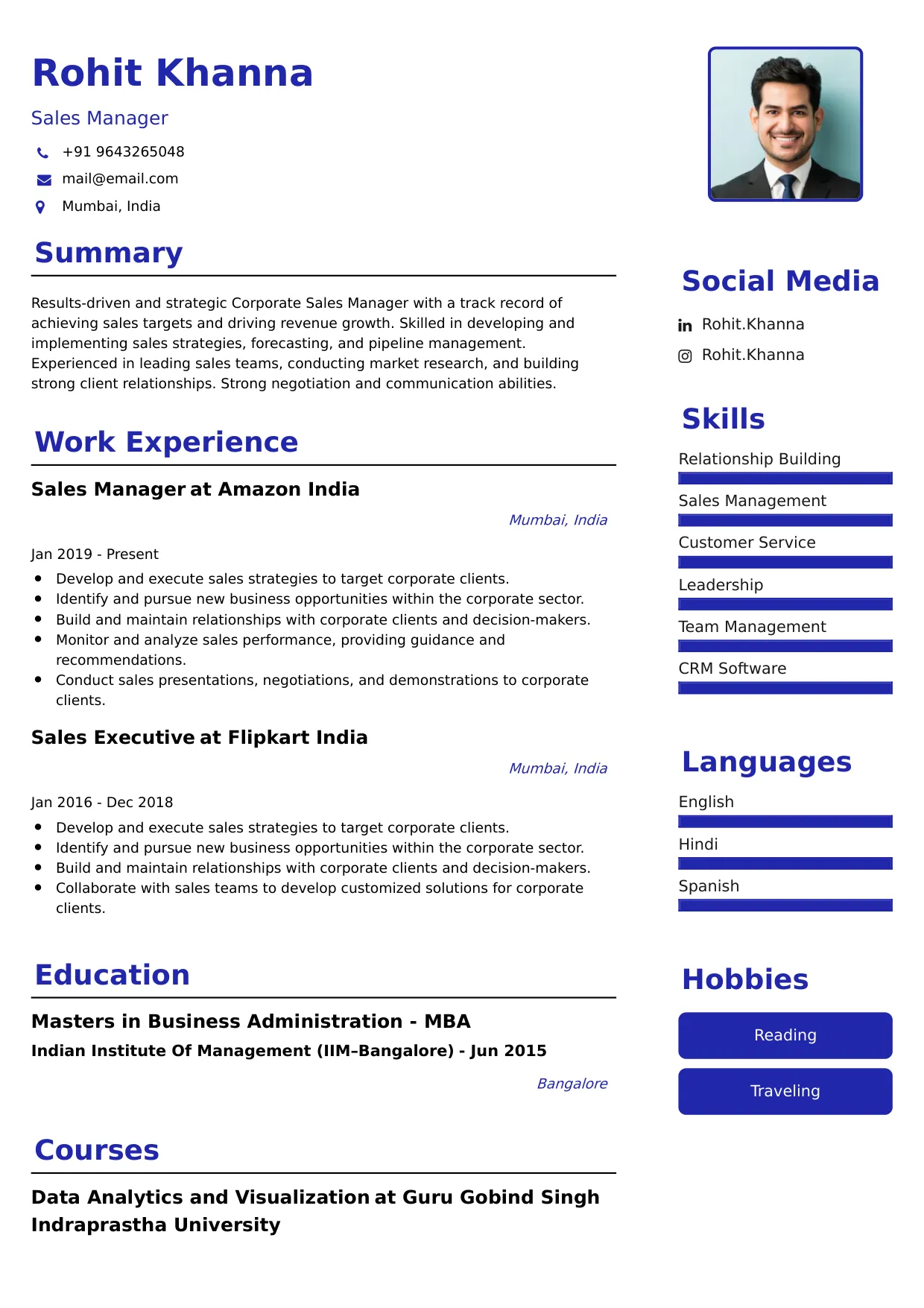
Dispatch Manager
Welcome to our Dispatch Manager resume sample page! This expertly crafted resume template is designed to showcase your expertise in logistics, fleet management, real-time route optimization, team leadership, and regulatory compliance in transportation or emergency services. Whether you're an ascending leader or a seasoned professional, this sample highlights key skills like TMS (Transportation Management Systems), DOT regulations, driver/operator scheduling, and crisis communication tailored to meet top logistics and public safety demands. Use this guide to create a compelling resume that stands out and secures your next career opportunity.Build a Standout Dispatch Manager Resume with Superbresume.com
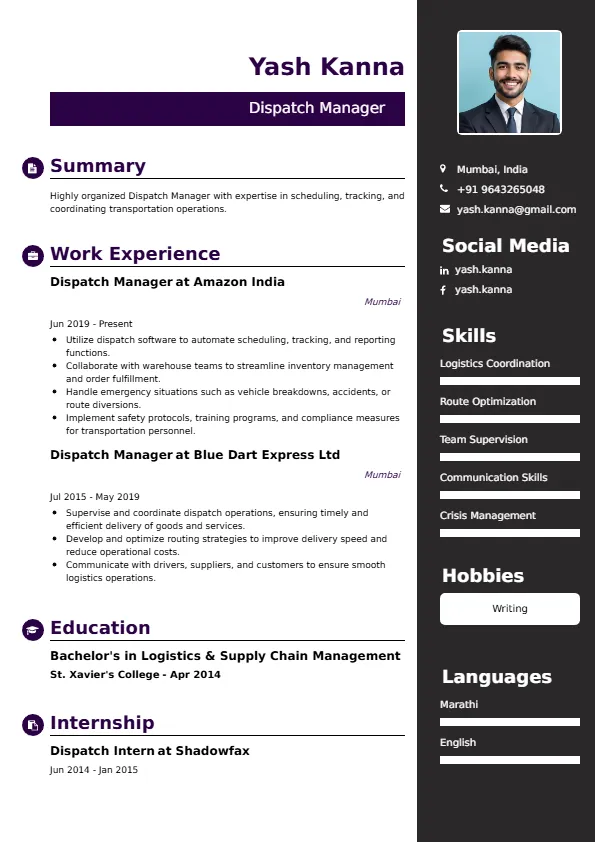
Superbresume.com empowers Dispatch Managers to craft resumes that highlight their operational efficiency and team leadership expertise. Our platform offers customizable templates tailored for logistics and transportation roles, emphasizing skills like advanced route planning, electronic logging device (ELD) management, safety compliance, and performance metrics tracking. With ATS-optimized formats, expert-written content suggestions, and real-time resume analysis, we ensure your resume aligns with job descriptions. Showcase your experience in dramatically reducing idle time, managing a large fleet and dispatch team, or maintaining superior on-time delivery (OTD) rates with confidence. Whether you manage commercial trucking or emergency services, Superbresume.com helps you create a polished, results-driven resume that grabs hiring managers’ attention and lands interviews.
How to Write a Resume for a Dispatch Manager
Use Reverse-Chronological Format: List recent dispatch or logistics management roles first, focusing on supervisory scope, efficiency metrics, and regulatory compliance.
Highlight Certifications/Training: Include credentials like Certified Transportation Professional (CTP), DOT/FMCSA compliance training, or specialized training in TMS software (e.g., McLeod, TMW) to boost credibility.
Quantify Achievements: Use metrics, e.g., “Improved On-Time Delivery (OTD) rate from 92% to 98% within one year,” or “Reduced annual fuel costs by 10% through route optimization and driver coaching,” to show impact.
Incorporate Keywords: Use terms like “Route Optimization,” “Fleet Management,” “TMS Administration,” “DOT Compliance,” “Real-Time Tracking,” or “Driver/Dispatch Scheduling” from job descriptions for ATS.
Detail Technical Skills: List proficiency with specific TMS/routing software, ELD systems, GPS tracking platforms, and communication technologies in a dedicated skills section.
Showcase Operational Improvements: Highlight 3-4 key projects (e.g., new software implementation, driver training program, route density analysis) and the resulting, quantified operational gains.
Emphasize Soft Skills: Include decisive leadership, crisis communication, rapid problem-solving (e.g., responding to delays/breakdowns), and strong team motivation.
Keep It Concise: Limit your resume to 1-2 pages, focusing on high-level operational strategy and measurable efficiency achievements.
Proofread Thoroughly: Eliminate typos or jargon for a professional document; accuracy in logistics data is crucial.
Predictive Route Planning: Highlight experience implementing AI or machine learning-based systems to forecast route times, account for weather/traffic, and optimize complex multi-stop routes.
Safety Culture Leadership: Showcase managing safety programs, ensuring compliance with HOS (Hours of Service), and reducing preventable accidents.
Last-Mile Delivery Optimization: Detail experience managing the unique challenges and technology required for high-volume, last-mile logistics (especially in urban environments).
Cross-Functional Communication: Emphasize aligning dispatch operations with warehouse/inventory teams and customer service to resolve issues quickly.
Metrics-Driven Achievements: Use results like “Managed a dispatch team of 25+ serving a fleet of 150 vehicles” or “Reduced driver overtime by 8% through effective scheduling.”
Cold Chain/Specialized Logistics: Include experience managing specialized transportation needs, such as temperature-controlled (reefer) or hazardous materials (Hazmat).
Paperless/Digital Workflow Adoption: Highlight implementing digital dispatching, manifest documentation, and electronic proof of delivery (ePOD).
Choose Superbresume.com to craft a Dispatch Manager resume that stands out in the fast-paced logistics and transportation sector. Our platform offers tailored templates optimized for ATS, ensuring your skills in route optimization, fleet technology, and regulatory compliance shine. With expert guidance, pre-written content, and real-time feedback, we help you highlight achievements like improving OTD rates or reducing operational costs. Whether you manage a commercial fleet or emergency response, our tools make it easy to create a professional, results-driven resume. Trust Superbresume.com to showcase your expertise in leading efficient, high-performance dispatch teams. Start building your career today!
20 Key Skills for a Dispatch Manager Resume
| Route Optimization & Planning | Transportation Management System (TMS) |
| Fleet Management & Tracking (GPS/Telematics) | DOT/FMCSA Compliance (HOS, ELD) |
| Real-Time Problem-Solving | Driver/Operator Scheduling |
| Crisis Communication | P&L/Cost Management (Fuel, Labor) |
| On-Time Delivery (OTD) Metrics | Electronic Logging Device (ELD) Management |
| Safety Program Oversight | Team Leadership & Coaching |
| Manifest Documentation | Inventory Coordination |
| Customer Service & Issue Resolution | Hazmat/Specialized Cargo (if applicable) |
| Data Analysis (Dispatch Metrics) | Load Planning & Capacity Utilization |
| Decisive Leadership | Team Motivation |
10 Do’s for a Dispatch Manager Resume
Tailor Your Resume: Customize for the type of dispatch (e.g., trucking/freight, utility, emergency services) and fleet size/type.
Highlight Certifications/Training: List CTP or specialized compliance/software training prominently.
Quantify Achievements: Include metrics on OTD rate improvement, cost reduction (fuel/labor), fleet size managed, or efficiency gains.
Use Action Verbs: Start bullet points with verbs like “optimized,” “managed,” “led,” “reduced,” or “implemented.”
Showcase Operational Improvements: Detail specific projects that improved routing efficiency, safety, or compliance.
Include Soft Skills: Highlight decisive leadership, crisis response ability, and excellent communication with drivers and customers.
Optimize for ATS: Use standard management section titles and incorporate key logistics and technology terms (e.g., “TMS,” “ELD,” “HOS”).
Keep It Professional: Use a clean, consistent font and professional layout.
Emphasize Technology: Clearly articulate your proficiency with the specific TMS and telematics systems used.
Proofread Carefully: Ensure no typos or errors in metrics or technical/regulatory acronyms.
10 Don’ts for a Dispatch Manager Resume
Don’t Overload with Jargon: Avoid confusing, internal company acronyms; use standardized logistics and regulatory terminology.
Don’t Exceed Two Pages: Keep your resume concise, focusing on high-level operational strategy and measurable efficiency gains.
Don’t Omit Dates: Include employment dates for career context.
Don’t Use Generic Templates: Tailor your resume specifically to the high-stakes, real-time logistics management of a Dispatch Manager.
Don’t List Irrelevant Skills: Focus on logistics, routing, fleet technology, and regulatory compliance.
Don’t Skip Metrics: Quantify results wherever possible; all achievements must link back to efficiency, cost, or safety.
Don’t Use Complex Formats: Avoid highly stylized elements or confusing graphics that might not suit a professional logistics environment.
Don’t Ignore Regulatory Compliance: Include examples of managing and ensuring adherence to DOT, HOS, and safety standards.
Don’t Include Outdated Experience: Omit non-management or low-level operational jobs over 15 years old.
Don’t Forget to Update: Refresh for new TMS implementations, successful safety initiatives, or significant efficiency milestones.
5 FAQs for a Dispatch Manager Resume
Prioritize TMS mastery, route optimization, DOT/HOS compliance, and a track record of improving On-Time Delivery (OTD) rates.
Use standard management section titles, avoid graphics, and include keywords like “Telematics,” “ELD,” and “Fleet Management.”
Yes, quantify cost reduction (fuel, labor) and operational efficiency gains to demonstrate management impact.
Detail the size of the team managed and specific initiatives for coaching, training, or motivating drivers/dispatchers to meet targets.
Use a reverse-chronological format to emphasize recent, high-level operational strategy and efficiency achievements.
Get 5x more interviews with our crafted Resumes. We make resumes that land jobs.

Get a Free Customized Cover Letter with Resume Expert Advice
with every resume order placed, you will get a free Customized Cover letter.