Medical Coding Specialist
Welcome to our Medical Coding Specialist resume sample page! This expertly crafted resume template is designed to showcase your expertise in assigning accurate CPT, ICD-10-CM, and HCPCS codes to patient encounters and services, ensuring compliance, and optimizing reimbursement for healthcare providers. Whether you work in a hospital, clinic, or remote coding setting, this sample highlights key skills like ICD-10-CM/PCS Mastery, CPT/HCPCS Coding, Auditing/Compliance, Anatomy/Pathophysiology Knowledge, and EMR/Encoder Proficiency tailored to meet top healthcare demands. Use this guide to create a compelling resume that stands out and secures your next career opportunity.
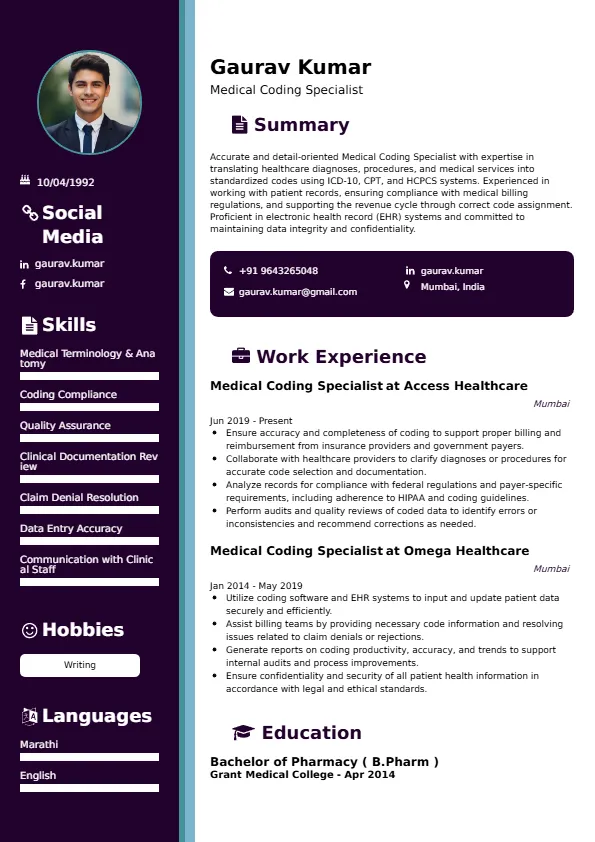
Superbresume.com empowers Medical Coding Specialists to craft resumes that highlight their coding accuracy and reimbursement optimization expertise. Our platform offers customizable templates tailored for coding roles, emphasizing skills like official coding guideline adherence (AHA/AMA), surgical/procedural coding, chart review/auditing, and encoder software proficiency. With ATS-optimized formats, expert-written content suggestions, and real-time resume analysis, we ensure your resume aligns with job descriptions. Showcase your experience in consistently achieving high coding accuracy (95%+) and production rates, resolving complex coding denials, or contributing to improved Case Mix Index (CMI) with confidence. Superbresume.com helps you create a polished, results-driven resume that grabs hiring managers’ attention and lands interviews.
How to Write a Resume for a Medical Coding Specialist
Craft a Targeted Summary: Write a 2-3 sentence summary highlighting your active professional coding certification, expertise in assigning accurate CPT/ICD-10 codes, and success in ensuring compliance, optimizing reimbursement, and maintaining high coding production/accuracy standards.
Use Reverse-Chronological Format: List recent coding, auditing, or relevant health information management roles first, focusing on measurable coding accuracy and production achievements.
Highlight Certifications/Training: Include credentials like Certified Professional Coder (CPC), Certified Coding Specialist (CCS), Specialty Coding Certifications (e.g., CIRCC), or relevant anatomy/pathophysiology training to boost credibility.
Quantify Achievements: Use metrics, e.g., “Consistently maintained a coding accuracy rate of 98% across 5,000+ charts annually (professional fee),” or “Increased departmental Case Mix Index (CMI) by 5% through accurate documentation and code capture,” to show impact.
Incorporate Keywords: Use terms like “ICD-10-CM/PCS Coding,” “CPT/HCPCS Coding,” “AAPC/AHIMA Certified (CPC/CCS),” “Coding Compliance & Auditing,” “Encoder Software (3M, Optum),” “Anatomy & Pathophysiology,” or “Reimbursement Optimization” from job descriptions for ATS.
Detail Technical/Coding Skills: List proficiency with specific coding software, EMR systems, official coding guidelines, regulatory compliance standards, and specialized coding areas (e.g., surgical, E&M) in a dedicated skills section.
Showcase Coding Success: Highlight 3-4 key responsibilities or projects (e.g., successfully coding complex surgical procedures, conducting internal coding audits, resolving high-value coding denials), detailing the scope and the accuracy/financial result.
Emphasize Soft Skills: Include meticulous attention to detail, analytical rigor (chart review), adherence to deadlines, organization, and strong communication (with physicians/billers).
Keep It Concise: Limit your resume to 1-2 pages, focusing on relevant coding, auditing, and compliance experience.
Proofread Thoroughly: Eliminate typos or jargon for a professional document.
ICD-10-CM/PCS Complexity: Focus on advanced proficiency in assigning complex ICD-10 codes, particularly in specialized areas like surgical procedures (PCS) or specific disease categories.
Coding Auditing and Compliance: Highlight expertise performing internal coding audits, identifying documentation deficiencies, and providing education to providers to improve coding capture and reduce fraud risk.
Documentation Improvement (CDI Support): Showcase experience collaborating with Clinical Documentation Improvement (CDI) specialists and providers to clarify ambiguous documentation, ensuring accurate code assignment and appropriate reimbursement.
Encoder and CAC (Computer Assisted Coding) Proficiency: Detail advanced proficiency utilizing coding software (e.g., 3M, Optum) and experience validating results generated by Computer Assisted Coding (CAC) tools.
E&M and Procedural Coding Rigor: Emphasize expertise assigning appropriate Evaluation and Management (E&M) levels and correctly coding complex surgical/procedural cases with modifiers.
Metrics-Driven Achievements: Use results like “Successfully reduced coding denial rates by 5% by focusing on authorization and modifier accuracy” or “Consistently maintained a production rate 10% above the department average.”
Telehealth and Virtual Care Coding: Include knowledge and experience accurately coding patient encounters delivered via telehealth platforms, adhering to specific payer guidelines for virtual services.
Regulatory Updates and Education: Highlight commitment to continuous learning regarding annual CPT/ICD-10 updates, payer changes, and translating these changes into internal coding policy.
Choose Superbresume.com to craft a Medical Coding Specialist resume that stands out in the critical revenue integrity sector. Our platform offers tailored templates optimized for ATS, ensuring your skills in CPC/CCS certification, coding accuracy, and reimbursement optimization shine. With expert guidance, pre-written content, and real-time feedback, we help you highlight achievements like boosting Case Mix Index or reducing coding denials. Whether you focus on professional fee or inpatient coding, our tools make it easy to create a polished, results-driven resume. Trust Superbresume.com to showcase your expertise in maximizing compliant revenue capture. Start building your career today!
20 Key Skills for a Medical Coding Specialist Resume
| ICD-10-CM/PCS Coding Mastery | CPT/HCPCS Coding & Modifier Application |
| CPC/CCS Certification (AAPC/AHIMA) | Coding Compliance & Auditing |
| EMR/EHR & Encoder Software Proficiency (3M/Optum) | Reimbursement Optimization & Case Mix Index (CMI) |
| Surgical & Procedural Coding | E&M (Evaluation and Management) Coding |
| Official Coding Guideline Adherence (AHA/AMA) | Anatomy & Pathophysiology Knowledge |
| Chart Review & Documentation Deficiency Identification | Coding Denial Resolution (Appeals) |
| Meticulous Attention to Detail | Productivity & Accuracy Rate Management |
10 Do’s for a Medical Coding Specialist Resume
Tailor Your Resume: Customize for the specific setting (e.g., inpatient/hospital coding, outpatient/professional fee coding) and the required specialty coding.
Highlight Certifications/Training: List CPC, CCS, and any specialty coding certifications prominently.
Quantify Achievements: Include metrics on coding accuracy rate (percentage), production volume (charts/day), CMI improvement, or denial reduction rate attributable to coding fixes.
Use Action Verbs: Start bullet points with verbs like “coded,” “audited,” “resolved,” “applied,” or “ensured.”
Showcase Coding Success: Detail the complexity and the accuracy/financial result of 3-4 key coding or auditing projects.
Include Soft Skills: Highlight meticulous detail, analytical rigor (chart review), and adherence to compliance guidelines.
Optimize for ATS: Use standard coding section titles and incorporate key coding systems, certifications, and compliance terms.
Keep It Professional: Use a clean, consistent font and professional layout.
Emphasize Accuracy and Compliance: Clearly articulate expertise in adhering to official guidelines and maximizing compliant reimbursement.
Proofread Thoroughly: Eliminate typos or errors; coding precision is vital.
10 Don’ts for a Medical Coding Specialist Resume
Don’t Overload with Jargon: Avoid confusing, internal facility or software acronyms; use standardized coding and health information management terminology.
Don’t Exceed Two Pages: Keep your resume concise, focusing on high-impact coding, auditing, and compliance achievements.
Don’t Omit Dates: Include employment dates for career context.
Don’t Use Generic Templates: Tailor your resume specifically to the detailed, rule-based duties of a Medical Coding Specialist.
Don’t List Irrelevant Skills: Focus on CPT/ICD-10, coding guidelines, auditing, and encoder software.
Don’t Skip Metrics: Quantify results wherever possible; accuracy, CMI, and production rate are critical metrics.
Don’t Use Complex Formats: Avoid highly stylized elements or confusing graphics.
Don’t Ignore EMR/Encoder: Include proficiency with the specific systems used for coding and abstracting.
Don’t Include Outdated Experience: Omit non-coding or non-HIM jobs over 15 years old.
Don’t Forget to Update: Refresh for new certification renewals, successful auditing projects, or advanced coding software proficiency.
5 FAQ's for a Medical Coding Specialist Resume
CPC (Certified Professional Coder) or CCS (Certified Coding Specialist). Place these after your name in the header.
"Consistently maintained a 98%+ coding accuracy rate during quarterly internal audits."
Yes. Prioritize ICD-10-CM, CPT, and HCPCS Level II.
"Collaborated with physicians to clarify documentation, increasing code specificity and capturing $200K in previously missed revenue."
Yes, mention "Successfully managed high-volume remote coding workflow with zero productivity lag."
Get 5x more interviews with our crafted Resumes. We make resumes that land jobs.

Get a Free Customized Cover Letter with Resume Expert Advice
with every resume order placed, you will get a free Customized Cover letter.