Transcriptionist
Welcome to our Transcriptionist resume sample page! This expertly crafted resume template is designed to showcase your expertise in transcribing and editing dictated or recorded audio/video content with high accuracy and speed, ensuring proper format, terminology, and adherence to confidentiality. Whether you work in medical, legal, or general corporate transcription, this sample highlights key skills like Transcription Speed/Accuracy (WPM), Medical/Legal Terminology Mastery, Confidentiality (HIPAA/Legal), Dictation Software Proficiency, and Quality Assurance (QA) tailored to meet top administrative and documentation demands. Use this guide to create a polished, results-driven resume that stands out and secures your next career opportunity.
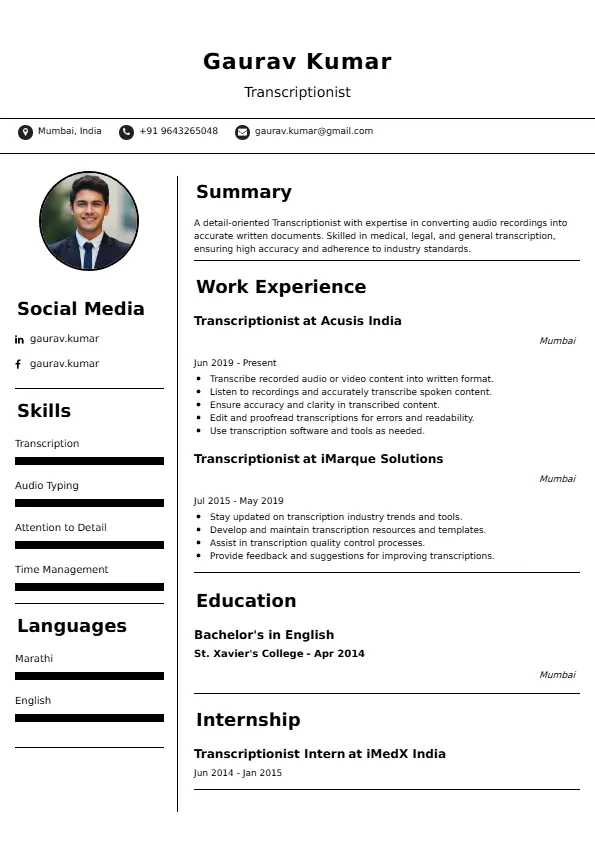
Superbresume.com empowers Transcriptionists to craft resumes that highlight their speed, accuracy, and domain-specific language expertise. Our platform offers customizable templates tailored for documentation roles, emphasizing skills like ESMT (Electronic Signature Management, if medical), diverse report type transcription, QA editing, and adherence to turnaround time (TAT) metrics. With ATS-optimized formats, expert-written content suggestions, and real-time feedback, we ensure your resume aligns with job descriptions. Showcase your experience in consistently achieving high transcription accuracy (99%+) and production volume, maintaining strict TAT for critical reports, or specializing in complex terminology fields with confidence. Superbresume.com helps you create a polished, results-driven resume that grabs hiring managers’ attention and lands interviews.
How to Write a Resume for a Transcriptionist
Craft a Targeted Summary: Write a 2-3 sentence summary highlighting your expertise in accurate transcription/editing, proficiency in specialized terminology and dictation software, and success in maintaining high production rates and strict confidentiality/documentation compliance.
Use Reverse-Chronological Format: List recent transcription, editing, or administrative roles first, focusing on measurable accuracy and productivity achievements.
Highlight Certifications/Training: Include credentials like Certified Medical Transcriptionist (CMT)/Registered Medical Transcriptionist (RMT), specialized language/terminology training, or relevant software certification to boost credibility.
Quantify Achievements: Use metrics, e.g., “Consistently maintained a transcription accuracy rate of 99.5% across all report types (e.g., legal/clinical), exceeding industry standards,” or “Transcribed 150+ lines per hour (LPH), completing 95% of reports within the mandated 4-hour Turnaround Time (TAT) benchmark,” to show impact.
Incorporate Keywords: Use terms like “Transcription Accuracy (WPM/LPH),” “Medical/Legal Terminology Mastery,” “HIPAA/Confidentiality Compliance,” “Dictation/Speech Recognition Software (e.g., Dragon),” “Quality Assurance (QA) Editing,” or “Turnaround Time (TAT) Management” from job descriptions for ATS.
Detail Technical/Linguistic Skills: List proficiency with specific dictation/editing software (e.g., Express Scribe, proprietary systems), foot pedals, knowledge of domain-specific terminology, and advanced typing/transcription speed in a dedicated skills section.
Showcase Productivity/Quality Success: Highlight 3-4 key responsibilities or projects (e.g., managing a high-volume queue, specializing in complex reports, developing internal style guides), detailing the scope and the accuracy/efficiency result.
Emphasize Soft Skills: Include meticulous attention to detail, linguistic competence, reliability (TAT), confidentiality, and strong organizational skills.
Keep It Concise: Limit your resume to 1 page, focusing on relevant transcription, language, and documentation experience.
Proofread Thoroughly: Eliminate typos or jargon for a professional document.
Speech Recognition Editing (SRE): Focus heavily on expertise reviewing and editing reports generated by automated speech recognition (ASR) software, ensuring the final text is accurate, especially for medical/legal content.
Quality Assurance and Auditing: Highlight experience performing QA on transcribed reports, identifying error patterns, and providing feedback/training to maintain high departmental accuracy rates.
Digital Documentation Flow: Showcase proficiency managing the flow of audio files and transcribed text into the final documentation system (e.g., EMR, case management software) and ensuring proper file naming/archiving.
Turnaround Time (TAT) Optimization: Detail advanced time management skills in prioritizing and completing urgent reports (e.g., stat reports, court filings) and consistently meeting strict service level agreements (SLAs).
HIPAA/Legal Confidentiality: Emphasize strict adherence to handling sensitive client/patient information (PHI, PII) and maintaining confidentiality, particularly when working remotely.
Metrics-Driven Achievements: Use results like “Successfully reduced transcription error rate passed to clients by 50% through refined double-check protocols” or “Maintained a consistent LPH rate 20 points above the company average.”
Specialty Terminology Mastery: Include advanced knowledge in high-value, complex specialties (e.g., cardiology, litigation discovery, market research interviews).
Template and Macro Creation: Highlight experience developing standardized templates, macros, or text expanders to improve transcription speed and consistency for repetitive report sections.
20 Key Skills for a Transcriptionist Resume
| Transcription Accuracy & Speed (WPM/LPH) | Domain Terminology Mastery (Medical/Legal/General) |
| Speech Recognition Editing (SRE) & QA | Turnaround Time (TAT) Management |
| Dictation Software & Foot Pedal Proficiency | Confidentiality (HIPAA/Legal) & Data Security |
10 Do’s for a Transcriptionist Resume
Tailor Your Resume: Customize for the specific domain (e.g., emphasize medical terminology, emphasize legal procedure).
Highlight Certifications/Training: List CMT/RMT or specialized legal transcription training prominently.
Quantify Achievements: Include metrics on LPH/WPM, accuracy rate (percentage), or TAT compliance percentage.
Use Action Verbs: Start bullet points with verbs like “transcribed,” “edited,” “maintained,” “ensured,” or “managed.”
Showcase Accuracy and Productivity: Detail the methodology and the strategic, quantified accuracy/efficiency result of 3-4 key transcription responsibilities.
Include Soft Skills: Highlight meticulous detail, linguistic competence, reliability, and strict adherence to confidentiality.
Optimize for ATS: Use standard administrative/documentation section titles and incorporate key terminology and software terms.
Keep It Concise: Limit your resume to one page, focusing on relevant transcription and documentation experience.
Emphasize Accuracy and TAT: Clearly articulate expertise in maintaining high quality and meeting critical deadlines.
Proofread Thoroughly: Eliminate typos or jargon for a professional document.
10 Don’ts for a Transcriptionist Resume
Don’t Overload with Jargon: Avoid confusing, internal facility or system acronyms; use standardized transcription and domain terminology.
Don’t Exceed One Page: Keep your resume sharp and focused on the most relevant, measurable duties.
Don’t Omit Dates: Include employment dates for career context.
Don’t Use Generic Templates: Tailor your resume specifically to the language and procedural duties of a Transcriptionist.
Don’t List Irrelevant Skills: Focus on transcription, domain terminology, software, QA, and documentation compliance.
Don’t Skip Metrics: Quantify results wherever possible; LPH, accuracy, and TAT are critical metrics.
Don’t Use Complex Formats: Avoid highly stylized elements or confusing graphics.
Don’t Ignore Technology: Include mastery of dictation/SRE software and foot pedal usage.
Don’t Include Outdated Experience: Omit non-documentation or non-administrative jobs over 10 years old.
Don’t Forget to Update: Refresh for new certification renewals, successful QA auditing experience, or advanced SRE proficiency.
5 FAQs for a Transcriptionist Resume
Prioritize Transcription Accuracy and Speed (WPM/LPH), domain-specific terminology mastery, Speech Recognition Editing (SRE), Dictation Software proficiency, and confidentiality/HIPAA compliance.
Use standard documentation section titles, avoid graphics, and include keywords like “SRE,” “TAT,” and “Confidentiality.”
Yes, quantifying speed (LPH or WPM) and accuracy (percentage) is the most important metric.
Detail experience performing QA checks on transcribed reports, identifying errors, and adhering to strict style guides.
Use a reverse-chronological format to emphasize your most recent, high-impact transcription and documentation achievements.
Get 5x more interviews with our crafted Resumes. We make resumes that land jobs.

Get a Free Customized Cover Letter with Resume Expert Advice
with every resume order placed, you will get a free Customized Cover letter.