Records Clerk
Welcome to our Records Clerk resume sample page! This expertly crafted resume template is designed to showcase your expertise in organizing, maintaining, retrieving, and archiving physical and digital records, ensuring data accuracy and strict adherence to confidentiality and retention policies. Whether you work in a corporate office, legal firm, or medical facility, this sample highlights key skills like Filing Systems (Alphabetical/Numerical), Document Management Software (DMS), Data Entry Accuracy, Confidentiality (HIPAA/Legal), and Records Retention Compliance tailored to meet top organizational demands. Use this guide to create a polished, results-driven resume that stands out and secures your next career opportunity.
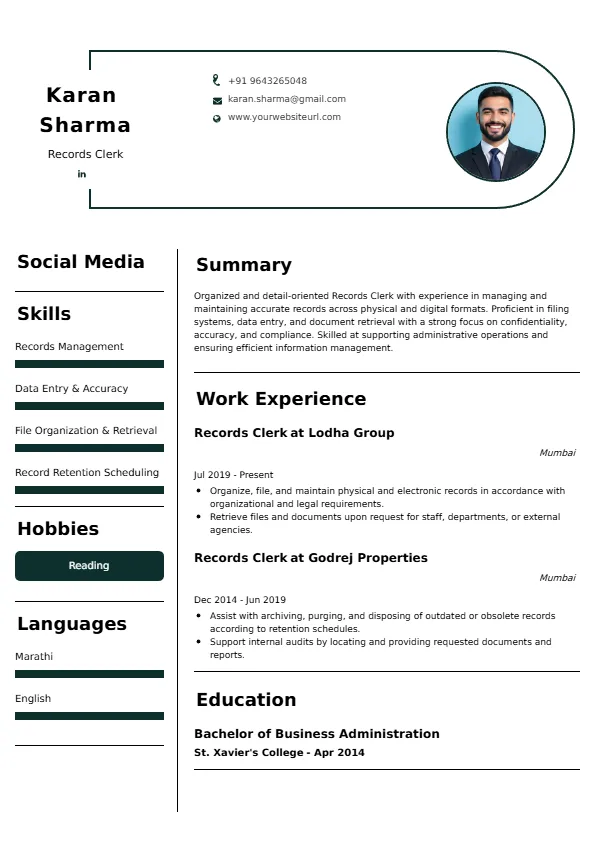
Superbresume.com empowers Records Clerks to craft resumes that highlight their organizational precision and information governance expertise. Our platform offers customizable templates tailored for administrative support roles, emphasizing skills like document scanning/indexing, archival procedures, database integrity, and efficient record retrieval. With ATS-optimized formats, expert-written content suggestions, and real-time resume analysis, we ensure your resume aligns with job descriptions. Showcase your experience in successfully managing large-scale document migrations (paper-to-digital), maintaining flawless accuracy in a high-volume filing system, or ensuring 100% compliance with strict legal retention schedules with confidence. Superbresume.com helps you create a polished, results-driven resume that grabs hiring managers’ attention and lands interviews.
How to Write a Resume for a Records Clerk
Craft a Targeted Summary: Write a 2-3 sentence summary highlighting your expertise in records management and documentation control, proficiency in filing systems (physical and digital), and success in ensuring data accuracy, quick retrieval, and strict confidentiality/compliance.
Use Reverse-Chronological Format: List recent records clerk, file clerk, or administrative support roles first, focusing on measurable organizational and accuracy achievements.
Highlight Certifications/Training: Include credentials like Certified Records Manager (CRM) Associate, specialized DMS/records software training, or relevant HIPAA/legal compliance training to boost credibility.
Quantify Achievements: Use metrics, e.g., “Managed the archives for 10,000+ active client files, maintaining 100% retrieval accuracy and reducing search time by 50%,” or “Completed the digital scanning and indexing of 50 boxes of historical records in 2 months, ensuring data security,” to show impact.
Incorporate Keywords: Use terms like “Records Management,” “Document Control,” “Filing Systems (Digital/Physical),” “Data Entry Accuracy,” “Confidentiality (HIPAA/Legal),” “Records Retention Policy,” “Document Management Software (DMS),” or “Archiving & Retrieval” from job descriptions for ATS.
Detail Organizational Skills: List proficiency with specific DMS software (e.g., SharePoint, Laserfiche), various filing methods (terminal digit, alphanumeric), inventory tracking, and strong adherence to data security protocols in a dedicated skills section.
Showcase Efficiency Projects: Highlight 3-4 key responsibilities or projects (e.g., leading a file room reorganization, managing the document destruction schedule, implementing a new indexing protocol), detailing the scope and the efficiency/accuracy result.
Emphasize Soft Skills: Include meticulous attention to detail, organizational excellence, discretion, reliability, and strong communication (internal request fulfillment).
Keep It Concise: Limit your resume to 1 page, focusing on relevant records management, data entry, and organizational experience.
Proofread Thoroughly: Eliminate typos or jargon for a professional document.
Digital Transformation and DMS Proficiency: Focus on expertise managing and migrating documents within Electronic Document Management Systems (DMS), including version control, access permissions, and auditing.
Data Privacy and Confidentiality: Highlight strict adherence to handling sensitive information, ensuring PHI/PII protection, and complying with HIPAA (medical) or privileged communication rules (legal).
Records Retention Automation: Showcase experience utilizing specialized software or automated workflows to manage the document lifecycle, ensuring records are held only for the legally required period and then securely destroyed.
Indexing and Search Optimization: Detail expertise in creating accurate and detailed metadata/indexing tags to maximize the searchability and rapid retrieval of digital records.
Audit and Compliance Readiness: Emphasize experience preparing and presenting records and documentation to internal or external auditors (e.g., legal discovery, financial audit).
Metrics-Driven Achievements: Use results like “Implemented a digital filing protocol that reduced document processing time by 20%” or “Maintained 100% compliance with the 7-year retention schedule for all financial records.”
Cross-Functional Records Support: Include experience providing specialized records support to multiple high-stakes departments (e.g., Legal, HR, Finance).
Security and Access Control: Highlight experience managing physical (locked cabinets) and digital (user permissions) access controls to sensitive information.
Choose Superbresume.com to craft a Records Clerk resume that stands out in the essential information governance sector. Our platform offers tailored templates optimized for ATS, ensuring your skills in document control, accuracy, and confidentiality shine. With expert guidance, pre-written content, and real-time feedback, we help you highlight achievements like streamlining retrieval processes or managing large-scale document migrations. Whether you manage patient charts or legal files, our tools make it easy to create a polished, results-driven resume. Trust Superbresume.com to showcase your expertise in reliable and meticulous information management. Start building your career today!
20 Key Skills for a Records Clerk
| Document Control & Management (Physical & Digital) | Filing Systems (Alphanumeric, Terminal Digit) |
| Data Entry Accuracy & Verification | Records Retention & Archiving Compliance |
| Confidentiality (HIPAA/Legal) & Data Security | Document Management Software (DMS/SharePoint) |
| Scanning, Indexing, & Metadata Tagging | File Retrieval (Rapid & Accurate) |
| Meticulous Attention to Detail | Organizational Excellence |
10 Do’s for a Records Clerk
Tailor Your Resume: Customize for the specific compliance environment (e.g., emphasize HIPAA for medical, emphasize e-discovery for legal).
Highlight Certifications/Training: List CRM Associate or relevant DMS/compliance training prominently.
Quantify Achievements: Include metrics on volume of records managed, accuracy rates, retrieval time reduction, or compliance success rates.
Use Action Verbs: Start bullet points with verbs like “managed,” “organized,” “filed,” “indexed,” or “maintained.”
Showcase Organizational Success: Detail the methodology and the strategic, quantified efficiency/accuracy result of 3-4 key records management projects.
Include Soft Skills: Highlight meticulous detail, organizational excellence, discretion, and reliability.
Optimize for ATS: Use standard administrative/records section titles and incorporate key filing and compliance terms.
Keep It Concise: Limit your resume to one page, focusing on relevant records management and organizational experience.
Emphasize Accuracy and Compliance: Clearly articulate expertise in ensuring data integrity and adherence to retention laws.
Proofread Thoroughly: Eliminate typos or jargon for a professional document.
10 Don’ts for a Records Clerk
Don’t Overload with Jargon: Avoid confusing, internal company or system acronyms; use standardized records management and compliance terminology.
Don’t Exceed One Page: Keep your resume sharp and focused on the most relevant, measurable duties.
Don’t Omit Dates: Include employment dates for career context.
Don’t Use Generic Templates: Tailor your resume specifically to the detailed, precision duties of a Records Clerk.
Don’t List Irrelevant Skills: Focus on records control, filing, data accuracy, archiving, and compliance.
Don’t Skip Metrics: Quantify results wherever possible; link achievements to accuracy, retrieval time, or compliance.
Don’t Use Complex Formats: Avoid highly stylized elements or confusing graphics.
Don’t Ignore Technology: Include explicit experience with DMS/records software and scanning technology.
Don’t Include Outdated Experience: Omit non-records or non-administrative jobs over 10 years old.
Don’t Forget to Update: Refresh for new software mastery, successful archiving projects, or advanced compliance training.
5 FAQ's for a Records Clerk
"Maintained a database of 20,000+ files with a 0% error rate during annual audit cycles."
Yes. Mention alphanumeric, terminal digit, or chronological filing expertise.
"Strictly adhered to HIPAA or GDPR data privacy standards for the handling of sensitive personnel/medical records."
Very. "Led the migration of 5,000 legacy paper files to a digital document management system (DMS)."
"Reduced record retrieval time by 40% through the implementation of a new barcode indexing system."
Get 5x more interviews with our crafted Resumes. We make resumes that land jobs.

Get a Free Customized Cover Letter with Resume Expert Advice
with every resume order placed, you will get a free Customized Cover letter.