Medical Office Assistant
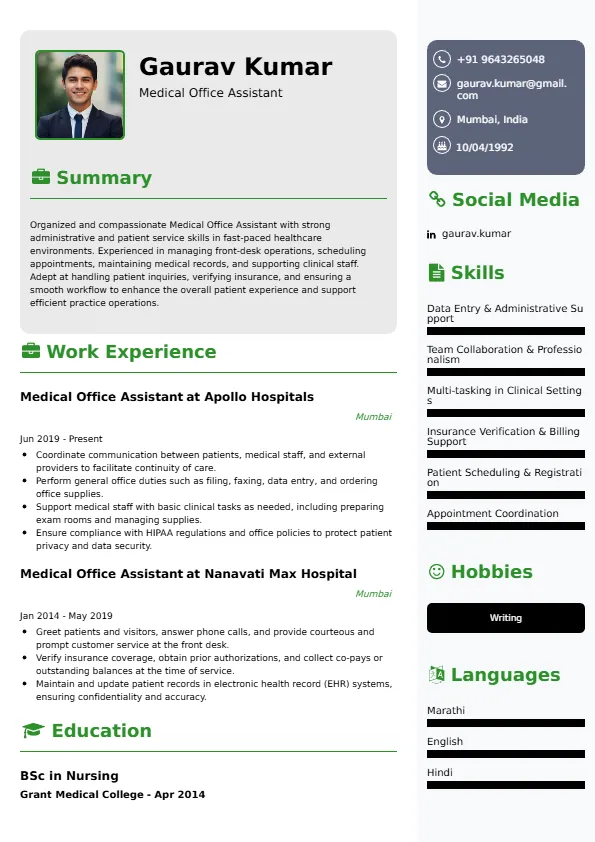
Welcome to our Medical Office Assistant (MOA) resume sample page! This expertly crafted resume template is designed to showcase your expertise in managing front office operations, patient scheduling, billing support, handling patient communication, and maintaining organized medical records in clinics, hospitals, or specialized practices. Whether you work in reception or administration, this sample highlights key skills like Scheduling/Registration, EMR/EHR Proficiency, Billing/Coding (Basic), Confidentiality (HIPAA), and Professional Patient Communication tailored to meet top healthcare demands. Use this guide to create a compelling resume that stands out and secures your next career opportunity.
Superbresume.com empowers Medical Office Assistants to craft resumes that highlight their administrative efficiency and patient service excellence. Our platform offers customizable templates tailored for healthcare support roles, emphasizing skills like insurance verification, co-pay collection, referral management, and streamlined patient check-in/out processes. With ATS-optimized formats, expert-written content suggestions, and real-time resume analysis, we ensure your resume aligns with job descriptions. Showcase your experience in successfully managing high call and patient volume, maintaining flawless patient records (HIPAA), or improving appointment scheduling accuracy with confidence. Superbresume.com helps you create a polished, results-driven resume that grabs hiring managers’ attention and lands interviews.a
How to Write a Resume for a Medical Office Assistant
Craft a Targeted Summary: Write a 2-3 sentence summary highlighting your expertise in medical office administration, proficiency in EMR systems and patient scheduling, and success in ensuring efficient patient flow, accurate record-keeping, and HIPAA compliance.
Use Reverse-Chronological Format: List recent MOA, medical reception, or administrative support roles first, focusing on measurable administrative and patient service achievements.
Highlight Certifications/Training: Include credentials like Certified Medical Administrative Assistant (CMAA), specialized EMR system training, or relevant HIPAA/billing compliance certification to boost credibility.
Quantify Achievements: Use metrics, e.g., “Managed scheduling for 3 physicians, maintaining a 95% patient confirmation rate and a 2% no-show rate,” or “Handled 75+ inbound patient calls and 50+ patient check-ins daily, ensuring a patient wait time of under 10 minutes,” to show impact.
Incorporate Keywords: Use terms like “EMR/EHR Proficiency (Scheduling/Registration),” “HIPAA Compliance,” “Patient Flow Management,” “Insurance Verification,” “Co-pay Collection & Reconciliation,” “Appointment Scheduling & Follow-up,” or “Medical Terminology” from job descriptions for ATS.
Detail Administrative/Technical Skills: List proficiency with specific EMR/PMS software (e.g., Epic, Cerner, Athena), multi-line phone systems, Microsoft Office Suite, basic medical coding/billing concepts, and electronic filing in a dedicated skills section.
Showcase Operational Success: Highlight 3-4 key responsibilities or projects (e.g., implementing a new patient reminder system, managing the referral process, coordinating patient records for a major audit), detailing the scope and the efficiency/compliance result.
Emphasize Soft Skills: Include professionalism, efficiency, meticulous attention to detail, strong patient communication, organization, and adherence to confidentiality.
Keep It Concise: Limit your resume to 1 page, focusing on relevant medical administrative, organizational, and patient service experience.
Proofread Thoroughly: Eliminate typos or jargon for a professional document.
EMR/EHR Integration and Workflow: Focus on deep proficiency utilizing EMR systems for all aspects of front office work, including insurance verification, patient registration, prior authorization tracking, and electronic record filing.
Patient Portal Management: Highlight experience assisting patients with setting up and utilizing the patient portal (e.g., messaging, appointment requests, bill pay) to streamline communication and engagement.
High-Volume Communication and Triage: Showcase expertise managing high volumes of patient calls and inquiries, quickly determining the nature of the request, and routing it efficiently (e.g., to the MA, RN, or billing).
Financial Management (Co-Pay/Deductible): Detail experience calculating co-pays/deductibles, collecting payments at the time of service, and performing daily cash/payment reconciliation.
Referral and Prior Authorization Tracking: Emphasize expertise managing the full lifecycle of specialist referrals and ensuring necessary prior authorizations are obtained before appointments or procedures.
Metrics-Driven Achievements: Use results like “Reduced patient no-show rate from 10% to 3% through an automated reminder system implementation” or “Achieved 99% accuracy in insurance verification for all scheduled appointments.”
Telehealth Appointment Coordination: Include experience scheduling and coordinating the logistics for virtual appointments, ensuring the patient and provider have the necessary technology access.
HIPAA and Confidentiality Rigor: Highlight strict adherence to all HIPAA regulations for patient data privacy and security in both physical and electronic record management.
Choose Superbresume.com to craft a Medical Office Assistant resume that stands out in the essential healthcare support sector. Our platform offers tailored templates optimized for ATS, ensuring your skills in EMR proficiency, scheduling, and patient flow management shine. With expert guidance, pre-written content, and real-time feedback, we help you highlight achievements like managing high patient volumes or improving no-show rates. Whether you support a large clinic or a small practice, our tools make it easy to create a polished, results-driven resume. Trust Superbresume.com to showcase your expertise in reliable, discreet, and efficient administrative patient care. Start building your career today!
20 Key Skills for a Medical Office Assistant Resume
| EMR/EHR Proficiency (Scheduling/Registration) | Appointment Scheduling & Patient Flow Management |
| HIPAA Compliance & Confidentiality | Insurance Verification & Eligibility Checks |
| Co-pay Collection & Daily Reconciliation | Multi-Line Phone System & Patient Inquiries |
| Referral & Prior Authorization Tracking | Medical Terminology & Coding/Billing (Basic) |
| Patient Portal Support | Administrative Support (Filing, Correspondence) |
| Meticulous Attention to Detail | Time Management & Prioritization |
10 Do’s for a Medical Office Assistant Resume
Tailor Your Resume: Customize for the specific medical specialty and the EMR/PMS software used (e.g., Epic, Athena).
Highlight Certifications/Training: List CMAA certification or relevant EMR system training prominently.
Quantify Achievements: Include metrics on patient volume managed, no-show rate reduction, payment collection accuracy, or efficiency gains in scheduling.
Use Action Verbs: Start bullet points with verbs like “managed,” “scheduled,” “processed,” “verified,” or “ensured.”
Showcase Operational Efficiency: Detail a process change or technology implementation that measurably improved patient flow or administrative speed.
Include Soft Skills: Highlight professionalism, efficiency, meticulous detail, and strong patient communication.
Optimize for ATS: Use standard medical section titles and incorporate key EMR, scheduling, and HIPAA terms.
Keep It Concise: Limit your resume to one page, focusing on relevant medical administrative and patient service experience.
Emphasize EMR and HIPAA: Clearly articulate expertise in the relevant EMR and strict adherence to patient confidentiality.
Proofread Thoroughly: Eliminate typos or jargon for a professional document.
10 Don’ts for a Medical Office Assistant Resume
Don’t Overload with Jargon: Avoid confusing, internal clinic or hospital acronyms; use standardized medical and EMR terminology.
Don’t Exceed One Page: Keep your resume sharp and focused on the most relevant, measurable MOA duties.
Don’t Omit Dates: Include employment dates for career context.
Don’t Use Generic Templates: Tailor your resume specifically to the front-office administrative and service duties of an MOA.
Don’t List Irrelevant Skills: Focus on scheduling, EMR, financial duties, and patient communication.
Don’t Skip Metrics: Quantify results wherever possible; link administrative work to flow efficiency, accuracy, or no-show rates.
Don’t Use Complex Formats: Avoid highly stylized elements or confusing graphics.
Don’t Ignore Financial Duties: Include explicit experience with co-pay collection and cash reconciliation.
Don’t Include Outdated Experience: Omit non-medical or irrelevant jobs over 10 years old.
Don’t Forget to Update: Refresh for new EMR module mastery, successful scheduling system implementations, or compliance training.
5 FAQ's for a Medical Office Assistant Resume
"Managed 5-line phone system while coordinating patient check-ins and insurance verification for 40+ patients daily."
Mention specific EMR/EHR front-office modules and scheduling software.
"Strictly enforced patient confidentiality and HIPAA standards in a high-traffic reception area."
Yes. "Applied advanced knowledge of medical terminology to accurately route clinical inquiries and triage calls."
Yes. "Coordinated 20+ outbound specialist referrals weekly, ensuring all prior authorizations were secured."
Get 5x more interviews with our crafted Resumes. We make resumes that land jobs.

Get a Free Customized Cover Letter with Resume Expert Advice
with every resume order placed, you will get a free Customized Cover letter.