File Clerk
Welcome to our File Clerk resume sample page! This expertly crafted resume template is designed to showcase your expertise in organizing, maintaining, retrieving, and archiving physical and digital records with meticulous attention to detail. Whether you're an entry-level candidate or a seasoned professional, this sample highlights key skills like alphabetical/numerical filing systems, document scanning, data entry accuracy, confidentiality, and office organization tailored to meet top legal, medical, and administrative demands. Use this guide to create a compelling resume that stands out and secures your next career opportunity.
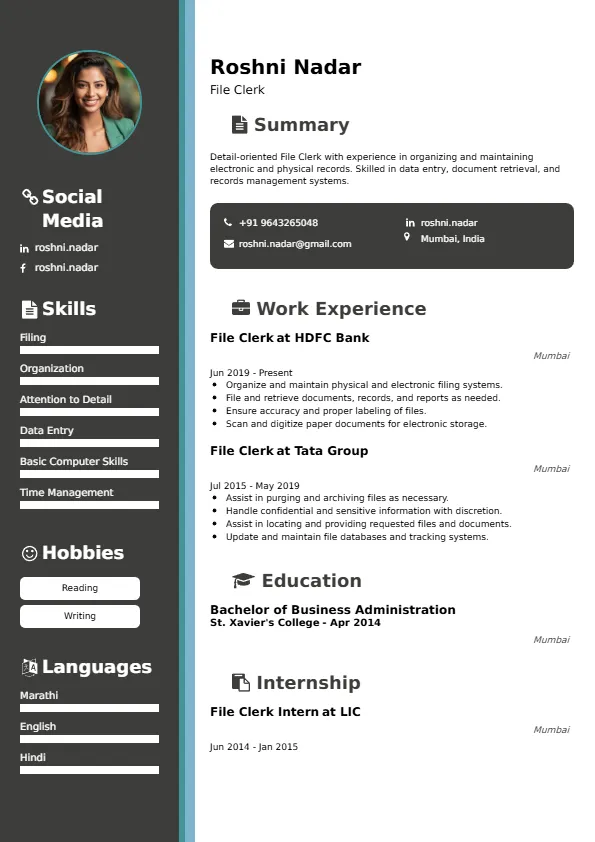
Superbresume.com empowers File Clerks to craft resumes that highlight their organizational precision and record management expertise. Our platform offers customizable templates tailored for administrative support roles, emphasizing skills like document management software (DMS), data integrity, regulatory compliance (e.g., HIPAA), and efficient file retrieval systems. With ATS-optimized formats, expert-written content suggestions, and real-time resume analysis, we ensure your resume aligns with job descriptions. Showcase your experience in migrating paper files to digital formats, managing large-scale archives, or ensuring flawless compliance during audits with confidence. Superbresume.com helps you create a polished, results-driven resume that grabs hiring managers’ attention and lands interviews.
How to Write a Resume for a File Clerk
Use Reverse-Chronological Format: List recent administrative, clerical, or data entry roles first, focusing on record management and organizational duties.
Highlight Certifications/Training: Include credentials like Certified Administrative Professional (CAP), relevant software mastery certifications (e.g., MS Office Suite), or specialized training in document management systems to boost credibility.
Quantify Achievements: Use metrics, e.g., “Maintained and archived over 5,000 active client files with 99.9% retrieval accuracy,” or “Completed the digital scanning and indexing of 100 boxes of historical documents in 3 months,” to show impact.
Incorporate Keywords: Use terms like “Document Control,” “Filing Systems (Alphabetical/Numerical),” “Data Entry Accuracy,” “Confidential Record Keeping,” “Document Scanning/Indexing,” “Records Management,” or “HIPAA/Regulatory Compliance” from job descriptions for ATS.
Detail Organizational Skills: List expertise in file retrieval, archiving, document shredding/destruction protocols, digital management software (DMS), and office organization in a dedicated skills section.
Showcase Efficiency Projects: Highlight 3-4 key projects or responsibilities (e.g., reorganizing a library, implementing a new scanning workflow), detailing the scope and the efficiency/accuracy gain achieved.
Emphasize Soft Skills: Include meticulous attention to detail, organization, reliability, discretion, and adherence to strict confidentiality protocols.
Keep It Concise: Limit your resume to 1 page, focusing on relevant record keeping, data entry, and organizational experience.
Proofread Thoroughly: Eliminate typos or jargon for a professional document; accuracy is the job's core requirement.
Paper-to-Digital Migration: Highlight successful experience in large-scale scanning, indexing, and digital organization projects, including quality assurance checks.
Data Privacy and Compliance: Showcase knowledge and adherence to industry-specific regulations (e.g., HIPAA in medical, legal confidentiality in law firms) related to record security and retention.
Records Retention Policy Enforcement: Detail experience in systematically managing the destruction and archiving of documents according to legal retention schedules.
Searchable Database Indexing: Emphasize skills in creating detailed metadata, indexing, and tagging for digital records to maximize future searchability and retrieval speed.
Metrics-Driven Achievements: Use results like “Reduced average file retrieval time from 5 minutes to 30 seconds via index restructuring” or “Maintained a database of 10,000+ entries with zero errors.”
Cross-Functional Support: Include experience supporting multiple departments (e.g., Legal, HR, Accounting) by retrieving and organizing specialized documentation.
Office Technology Proficiency: Highlight mastery of high-speed scanners, multi-function printers, and related document processing equipment.
Choose Superbresume.com to craft a File Clerk resume that stands out in the competitive administrative support field. Our platform offers tailored templates optimized for ATS, ensuring your skills in document control, data entry accuracy, and confidentiality shine. With expert guidance, pre-written content, and real-time feedback, we help you highlight achievements like streamlining filing systems or completing major document digitization projects. Whether you manage physical archives or digital repositories, our tools make it easy to create a polished, results-driven resume. Trust Superbresume.com to showcase your expertise in meticulous record management and operational efficiency. Start building your career today!
20 Key Skills for a File Clerk Resume
| Filing Systems (Alphabetical, Numerical, Chronological) | Document Scanning & Digital Indexing |
| Data Entry & Quality Control | Confidentiality & Discretion (HIPAA/Legal) |
| Document Management Software (DMS) Familiarity | Archiving & Records Retention Policy Adherence |
| File Retrieval (Rapid & Accurate) | Digital File Organization (Cloud/Network) |
| Microsoft Office Suite (Word, Excel) | Office Equipment Operation (Scanner, MFP) |
| Meticulous Attention to Detail | Organizational Excellence |
| Time Management & Prioritization | Inventory Management (Supplies) |
| Basic Office Administration | Cross-Functional Support |
| Document Shredding & Destruction Protocol | Database Data Entry |
10 Do’s for a File Clerk Resume
Tailor Your Resume: Customize for the industry (e.g., emphasize HIPAA for medical, emphasize Legal indexing for law firms).
Highlight Certifications/Training: List CAP or relevant software mastery certifications prominently.
Quantify Achievements: Include metrics on volume of files managed, accuracy rates, or time saved through organizational improvements.
Use Action Verbs: Start bullet points with verbs like “filed,” “organized,” “maintained,” “indexed,” or “scanned.”
Showcase Organization Projects: Detail specific projects where you successfully migrated, reorganized, or streamlined a complex filing system.
Include Soft Skills: Highlight exceptional attention to detail, reliability, discretion, and organizational rigor.
Optimize for ATS: Use standard administrative section titles and incorporate key filing system and document control terms.
Keep It Concise: Limit your resume to one page, focusing on relevant record keeping and administrative experience.
Emphasize Accuracy and Confidentiality: Clearly articulate experience handling sensitive information and maintaining flawless data integrity.
Proofread Carefully: Ensure no typos or errors; this demonstrates the quality of your work.
10 Don’ts for a File Clerk Resume
Don’t Overload with Jargon: Avoid confusing, internal company acronyms; use standardized filing and administrative terminology.
Don’t Exceed One Page: Keep your resume sharp and focused on the most relevant clerical and organizational duties.
Don’t Omit Dates: Include employment dates for career context.
Don’t Use Generic Templates: Tailor your resume specifically to the meticulous, detail-oriented duties of a File Clerk.
Don’t List Irrelevant Skills: Focus on filing, document control, data entry, organization, and compliance.
Don’t Skip Metrics: Quantify results wherever possible; link organization work to retrieval time or accuracy rates.
Don’t Use Complex Formats: Avoid highly stylized elements or confusing graphics.
Don’t Ignore Digital Skills: Include proficiency with scanners, DMS, and cloud/network filing.
Don’t Include Outdated Experience: Omit non-clerical or irrelevant jobs over 15 years old.
Don’t Forget to Update: Refresh for new software mastery, successful file migrations, or improved indexing protocols.
5 FAQs for a File Clerk Resume
Prioritize accuracy in data entry/filing, knowledge of various filing systems (A-Z/numerical), document control, and strict confidentiality adherence.
Use standard section titles, avoid graphics, and include keywords like “Document Control,” “Archiving,” and “Data Entry Accuracy.”
Yes, quantifying the number of files or records managed demonstrates the scale of responsibility and organizational ability.
State adherence to specific privacy regulations (e.g., HIPAA) or detail responsibilities involving sensitive records (e.g., Legal, HR).
Use a reverse-chronological format to emphasize your most recent, high-impact administrative and organizational achievements.
Get 5x more interviews with our crafted Resumes. We make resumes that land jobs.

Get a Free Customized Cover Letter with Resume Expert Advice
with every resume order placed, you will get a free Customized Cover letter.