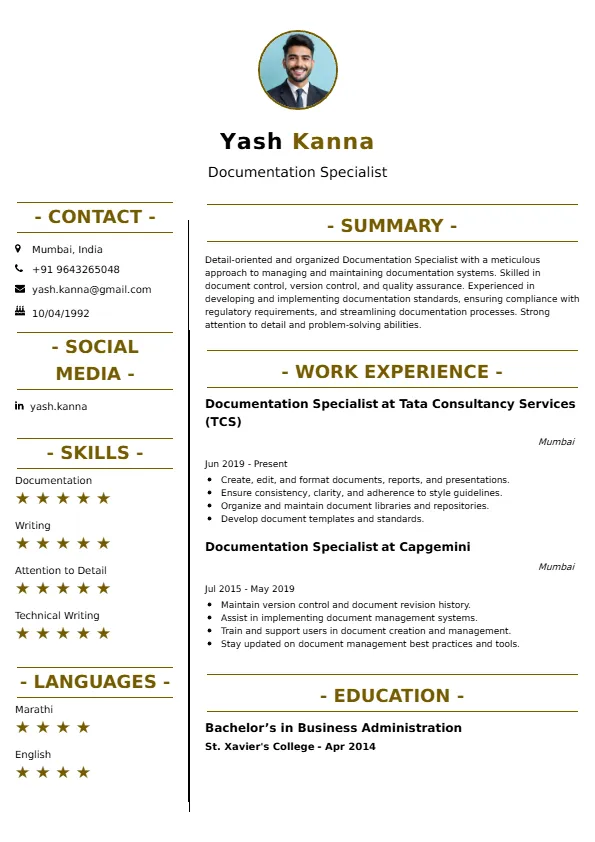
Documentation Specialist

Welcome to our Documentation Specialist resume sample page! This expertly crafted resume template is designed to showcase your expertise in creating, managing, and maintaining technical, regulatory, or procedural documentation across various industries (e.g., IT, Pharma, Manufacturing). Whether you're an entry-level candidate or a seasoned professional, this sample highlights key skills like content management systems (CMS), technical writing, regulatory compliance (e.g., ISO, FDA), and version control tailored to meet top employers’ demands. Use this guide to create a compelling resume that stands out and secures your next career opportunity.

Mid Level
Senior Level
null
Build a Standout Documentation Specialist Resume with Superbresume.com

Superbresume.com empowers Documentation Specialists to craft resumes that highlight their precision and information management expertise. Our platform offers customizable templates tailored for technical and regulatory roles, emphasizing skills like SOP drafting, DITA/XML authoring, quality assurance (QA) documentation, and efficient content review workflows. With ATS-optimized formats, expert-written content suggestions, and real-time resume analysis, we ensure your resume aligns with job descriptions. Showcase your experience in streamlining document control processes, migrating content to new platforms, or maintaining compliance in high-stakes environments with confidence. Whether you manage software manuals or clinical trial documentation, Superbresume.com helps you create a polished, results-driven resume that grabs hiring managers’ attention and lands interviews.

How to Write a Resume for a Documentation Specialist

Craft a Targeted Summary: Write a 2-3 sentence summary highlighting your expertise in end-to-end documentation management, proficiency in creating clear and concise technical content, and success in ensuring regulatory compliance and information accessibility.
Use Reverse-Chronological Format: List recent documentation or technical writing roles first, focusing on content creation, control, and governance responsibilities.
Highlight Certifications/Training: Include credentials like Technical Writer Certification (STC), Quality Management certifications (e.g., ISO 9001), or specialized tool training (e.g., Adobe Acrobat Pro) to boost credibility.
Quantify Achievements: Use metrics, e.g., “Reduced document retrieval time by 30% by implementing a new CMS structure,” or “Managed the revision control for over 500 critical Standard Operating Procedures (SOPs),” to show impact.
Incorporate Keywords: Use terms like “Document Control,” “Technical Writing,” “SOPs,” “CMS,” “Version Control (Git),” “Regulatory Compliance (e.g., FDA, ISO),” or “Information Architecture” from job descriptions for ATS.
Detail Technical Skills: List proficiency with specific tools (e.g., SharePoint, Confluence, FrameMaker, MadCap Flare), markup languages (HTML, XML/DITA), and graphic tools (SnagIt, Visio) in a dedicated skills section.
Showcase Documentation Types: Highlight the range of documents you have created or managed (e.g., User Manuals, Design Specifications, Training Materials, Quality Records, Clinical Protocols).
Emphasize Soft Skills: Include meticulous attention to detail, precision, strong written communication, and cross-functional collaboration (with SMEs, QA, Legal).
Keep It Concise: Limit your resume to 1-2 pages, focusing on relevant content management and technical communication experience.
Proofread Thoroughly: Eliminate typos or jargon for a professional document; accuracy is paramount.
Trends in Documentation Specialist Resume
Structured Content and DITA: Focus on expertise using structured authoring environments (DITA/XML) for modular content creation and multi-channel publishing.
Content Migration and CMS Mastery: Highlight experience moving legacy documentation into modern Content Management Systems (e.g., moving from Word docs to a knowledge base like Confluence or SharePoint).
Regulatory Auditing and Compliance: Showcase a strong background in preparing and managing documentation required for external audits (e.g., FDA inspections, ISO certification renewal).
Agile Documentation: Detail experience integrating documentation creation into agile development sprints and maintaining living documents in parallel with rapid product changes.
Information Architecture (IA): Emphasize skills in designing intuitive organization and navigation structures for large knowledge bases or technical libraries.
Metrics-Driven Achievements: Use results like “Reduced documentation errors by 90% via a new peer review process” or “Completed migration of 1,000 documents to the new CMS on time.”
Documentation as Code (Docs-as-Code): Include experience using version control (Git) and static site generators (Sphinx, Jekyll) for engineering documentation.
Accessibility Standards: Highlight work ensuring documents meet accessibility requirements (e.g., Section 508, WCAG) for all users.
Why Superbresume.com is Your Best Choice for a Documentation Specialist Resume

Choose Superbresume.com to craft a Documentation Specialist resume that stands out in the details-driven technical sector. Our platform offers tailored templates optimized for ATS, ensuring your skills in document control, technical writing, and compliance governance shine. With expert guidance, pre-written content, and real-time feedback, we help you highlight achievements like streamlining workflows or ensuring audit readiness. Whether you specialize in software documentation or quality assurance, our tools make it easy to create a professional, results-driven resume. Trust Superbresume.com to showcase your expertise in managing critical organizational knowledge. Start building your career today!

20 Key Skills for a Documentation Specialist Resume
                                           
Document Control & GovernanceTechnical Writing & Editing
Content Management Systems (CMS)Regulatory Compliance (FDA/ISO)
Standard Operating Procedure (SOP) DraftingVersion Control (e.g., SharePoint, Git)
Information ArchitectureQuality Assurance (QA) Documentation
DITA/XML AuthoringConfluence/Jira
Adobe Acrobat Pro/FrameMakerStyle Guide Adherence
Cross-Functional CollaborationSubject Matter Expert (SME) Interviewing
Process Flowcharting (Visio)Content Migration
Attention to DetailProofreading & Copyediting
Audit ReadinessAgile/Scrum Environments

10 Do’s for a Documentation Specialist Resume

Tailor Your Resume: Customize for the industry's documentation focus (e.g., IT software, manufacturing QA, clinical trials).

Highlight Certifications/Training: List technical writing or quality management certifications prominently.

Quantify Achievements: Include metrics on the volume of documents managed, efficiency gains in workflow, or successful audit participation.

Use Action Verbs: Start bullet points with verbs like “managed,” “drafted,” “implemented,” “streamlined,” or “maintained.”

Showcase Documentation Types: Detail the variety of complex documents you have successfully created and maintained.

Include Soft Skills: Highlight precision, collaboration, and the ability to translate complex information simply.

Optimize for ATS: Use standard section titles and incorporate key technical and regulatory terms.

Keep It Professional: Use a clean, consistent font and professional layout.

Emphasize Tool Mastery: Clearly list the specific CMS and authoring tools you are proficient with.

Proofread Carefully: Ensure no typos or errors; this is the job's core requirement.

10 Don’ts for a Documentation Specialist Resume

Don’t Overload with Jargon: Avoid confusing, internal company or highly specialized acronyms; use standardized industry terms.

Don’t Exceed Two Pages: Keep your resume concise, focusing on relevant, measurable documentation and control achievements.

Don’t Omit Dates: Include employment dates for career context.

Don’t Use Generic Templates: Tailor your resume specifically to the technical and governance duties of a Documentation Specialist.

Don’t List Irrelevant Skills: Focus on writing, content management, compliance, and process flow.

Don’t Skip Metrics: Quantify results wherever possible; link documentation work to operational efficiency or risk reduction.

Don’t Use Complex Formats: Avoid highly stylized elements or confusing graphics that might obscure content.

Don’t Ignore Compliance: Include explicit experience ensuring documentation meets legal/industry regulations.

Don’t Include Outdated Experience: Omit non-documentation or non-writing jobs over 15 years old.

Don’t Forget to Update: Refresh for new CMS migrations, successful audits, or advanced authoring tool mastery.

Prioritize document control and governance, technical writing/editing, CMS proficiency, and regulatory compliance expertise (e.g., ISO, FDA).

Use standard section titles, avoid graphics, and include keywords like “SOPs,” “Version Control,” and specific tools (e.g., “Confluence,” “FrameMaker”).

Yes, offering a link to a professional, non-confidential writing sample or portfolio is highly recommended.

Detail the specific regulations (e.g., 21 CFR Part 11, ISO 9001) and your role in ensuring documents met audit readiness standards.

Use a reverse-chronological format to emphasize your most recent, high-level document control and content creation achievements.

Get Your Professional Resume Written by Experts !

Get 5x more interviews with our crafted Resumes. We make resumes that land jobs.

Build Resume

Get a Free Customized Cover Letter with Resume Expert Advice

with every resume order placed, you will get a free Customized Cover letter.

Build Your ATS Resume in 5 Minutes!