Medical Transcriptionist
Welcome to our Medical Transcriptionist cover letter sample page! This professionally designed template is crafted to highlight your exceptional listening skills, meticulous attention to detail, and proven ability to accurately convert dictated medical reports into written format. Whether you’re working for a healthcare provider, a transcription service, or as an independent contractor, this sample emphasizes key skills like medical terminology, anatomy & physiology knowledge, pharmacology, accurate typing (WPM), voice recognition software (VRS) editing, HIPAA compliance, and quality assurance. Tailored to meet 2025 employer expectations, this guide will help you create a compelling cover letter that stands out in the competitive healthcare support field and secures your next vital role.
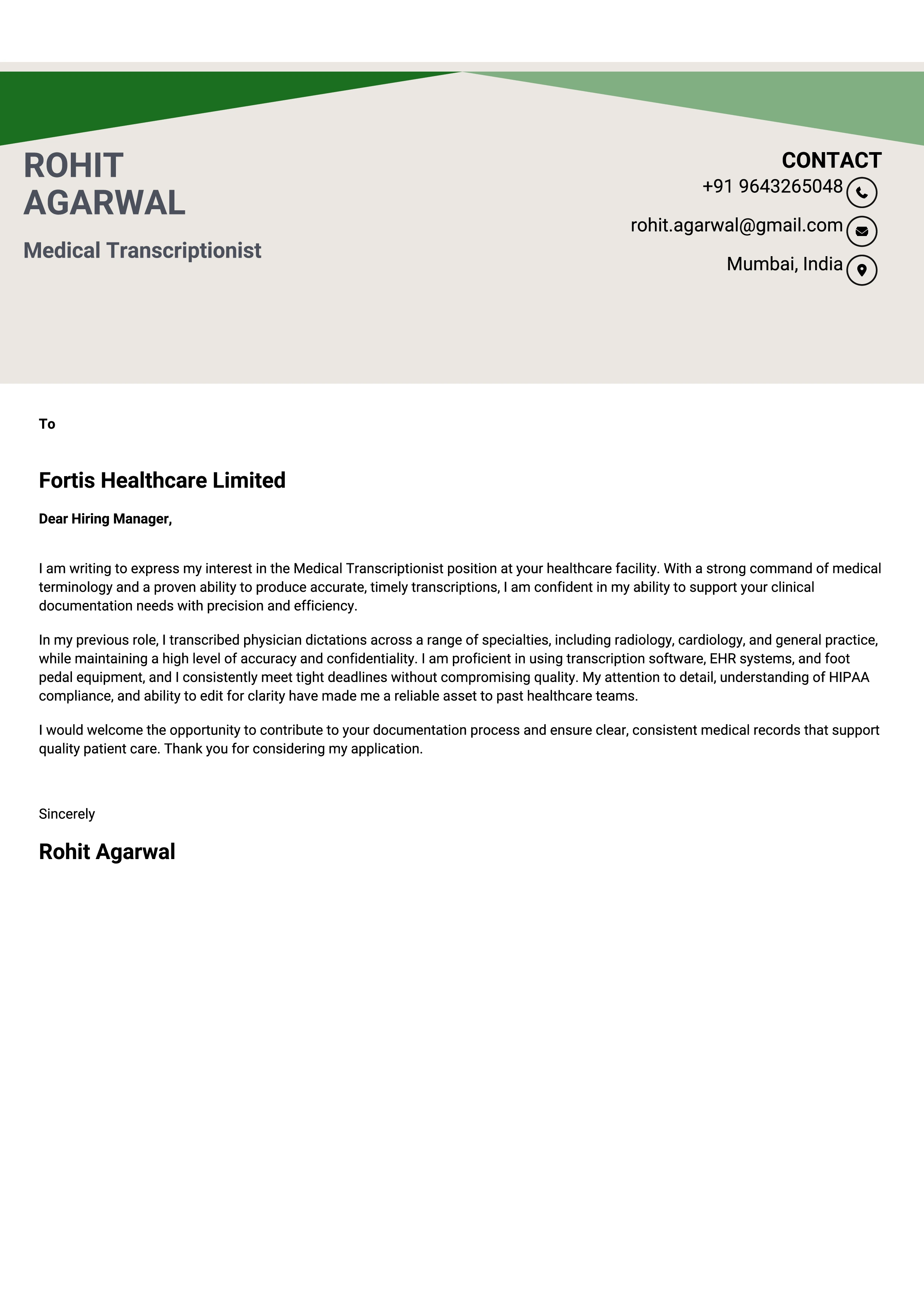
Superbresume.com empowers Medical Transcriptionists to craft cover letters that showcase their precision and efficiency in clinical documentation. Our platform provides customizable templates tailored for demanding healthcare administrative roles, emphasizing expertise in accurate report generation, medical terminology, and strict confidentiality. With ATS-optimized formats, expert-written content suggestions, and real-time feedback, we ensure your cover letter aligns with compliance and quality goals. Highlight achievements like consistently achieving high accuracy rates, improving turnaround times, efficiently editing voice recognition software output, or supporting seamless clinical workflows with confidence. Superbresume.com helps you create a polished, results-driven cover letter that grabs hiring managers’ attention and lands interviews for leading medical transcription positions.
How to Write a Cover Letter for a Medical Transcriptionist
Address the Hiring Manager: Use the hiring manager’s name (e.g., “Dear Ms. Lopez”) to personalize the letter and show attention to detail.
Highlight Relevant Experience: Focus on your experience with transcribing various report types (e.g., H&Ps, operative reports, discharge summaries), editing voice recognition software output, applying medical terminology and pharmacology knowledge, adhering to transcription guidelines, and ensuring HIPAA compliance.
Quantify Achievements: Use metrics prominently, e.g., “Maintained a 99% accuracy rate across 200+ medical reports weekly, exceeding quality benchmarks,” or “Consistently met or exceeded daily production quotas of 1,200 lines per day.”
Incorporate Keywords: Include terms like “medical transcription,” “voice recognition editing (VRE),” “medical terminology,” “anatomy & physiology,” “pharmacology,” “HIPAA compliance,” “EHR/EMR (documentation),” “accurate typing (WPM),” “quality assurance (transcription),” “report formatting,” or “clinical documentation” from the job description to pass ATS filters.
Showcase Software & Equipment Proficiency: Mention mastery of transcription software, foot pedals, headsets, and familiarity with Electronic Health Record (EHR) systems for context.
Emphasize Attention to Detail & Auditory Acuity: Highlight your meticulous approach to listening, identifying nuances in dictation, and ensuring grammatical/medical accuracy.
Demonstrate Time Management & Productivity: Include your ability to manage high volumes of dictation and meet strict turnaround times.
Keep It Concise: Limit the cover letter to one page, focusing on your most impactful contributions to clinical documentation integrity.
Close with Enthusiasm: End with a strong call to action, e.g., “I am eager to apply my precise medical transcription expertise to ensure the clarity and efficiency of [Company/Clinic Name]'s patient records.”
EHR Integration & Direct Charting: Showcase proficiency in transcribing directly into EHR systems, navigating various templates, and ensuring seamless integration of transcribed reports.
Quality Assurance (QA) for Automated Processes: Focus on your role in auditing and ensuring the quality of reports generated by automated or AI-assisted transcription services.
Specialty-Specific Terminology: Highlight advanced knowledge in niche medical terminology (e.g., cardiology, radiology, orthopedics) for highly specialized reports.
Data Privacy & Security: Strong emphasis on HIPAA compliance and best practices for securing protected health information (PHI) throughout the transcription workflow.
Remote Work & Digital Collaboration: Expertise in working remotely, utilizing secure online platforms for dictation/transcription, and collaborating with remote teams.
Problem-Solving (Dictation Clarity): Demonstrate ability to research unclear dictation, cross-reference patient information, and resolve inconsistencies for accurate documentation.
Training & Mentoring (Junior Transcribers): If applicable, experience in training or mentoring less experienced transcriptionists on quality standards and best practices.
Choose Superbresume.com to craft a Medical Transcriptionist cover letter that truly captures precision. Our platform offers tailored templates optimized for ATS, ensuring your expertise in accurate report generation, medical terminology, and voice recognition editing shines. With expert guidance, pre-written content, and real-time feedback, we help you highlight achievements like consistently achieving high accuracy rates, improving turnaround times, or supporting seamless clinical workflows. Whether you’re transcribing operative reports or discharge summaries, our tools make it easy to create a polished, results-driven cover letter. Trust Superbresume.com to showcase your indispensable skills and secure interviews for vital documentation positions.
20 Key Skills
| Medical Terminology (Advanced) | Anatomy & Physiology Knowledge |
| Pharmacology Knowledge | Accurate Typing (High WPM) |
| Voice Recognition Software (VRS) Editing | Transcription Software Proficiency |
| HIPAA Compliance | Electronic Health Records (EHR) Familiarity |
| Quality Assurance (Transcription) | Report Formatting (H&P, Operative, Discharge) |
| Active Listening & Auditory Acuity | Problem-Solving (Unclear Dictation) |
| Attention to Detail | Time Management & Productivity |
| Confidentiality & Discretion | Grammar, Punctuation, Spelling |
| Dictaphone / Foot Pedal Operation | Pathophysiology (Basic) |
| Communication Skills (Clarification) | Research Skills (Medical) |
10 Do’s
Lead with Accuracy & Efficiency
Highlight Medical Knowledge
Quantify Achievements
Showcase VRS Editing Skills
Discuss HIPAA Compliance
Optimize for ATS
Keep It Professional & Meticulous
Mention Attention to Detail
Proofread Meticulously
10 Don’ts
Don’t Be Vague About Report Types
Don’t Exceed One Page
Don’t Skip Typing Speed/Accuracy
Don’t Use Complex Formats
Don’t Omit HIPAA Compliance
Don’t Focus Only on Typing
Don’t Ignore Quality Assurance
Don’t Include Irrelevant Experience
Don’t Forget to Update
5 FAQs
Prioritize medical terminology, accurate typing (WPM), voice recognition software (VRS) editing, HIPAA compliance, and attention to detail.
Use standard formatting, avoid graphics, and include keywords like “clinical documentation,” “healthcare transcription,” “report generation,” and specific VRS/EHR systems from the job description.
Yes, if relevant to the job opening (e.g., “experience in surgical dictation,” “familiar with oncology reports”).
Describe your process for overcoming unclear audio, diverse accents, or complex medical jargon, including your research methods and communication with physicians for clarification, to ensure a high accuracy rate.
Use a professional, precise, meticulous, and reliable tone, conveying your dedication to producing high-quality, accurate medical documentation that supports clinical care and billing.
Get 5x more interviews with our crafted Resumes. We make Cover Letter that land jobs.

Free Customized Cover Letter + Expert Resume Advice
Receive a professionally tailored cover letter absolutely free with every resume order—plus expert guidance to make your resume stand out.